✍️ By Manish Kataria, CFA. My own views as a professional investor, not Ai.
Note: I wrote this in September 2021, so the valuation figures below are as at that date.

This week, we began our latest Investment Accelerator with an initial session around diversification of asset classes, compounding your returns and how to beat the inflation monster, amongst other things.
During the Q&A session we had a lively discussion around equity valuations … which I thought would be useful to articulate further here.
💡 Get insights like this weekly, straight to your inbox. Leave your details in the box at the top ☝🏼
If you’re worried about equity valuations as a reason NOT to invest, I hope this provides some balance. At the end of this article, I share a couple of simple tips on how to keep investing, EVEN if you remain cautious.
Equity Valuations
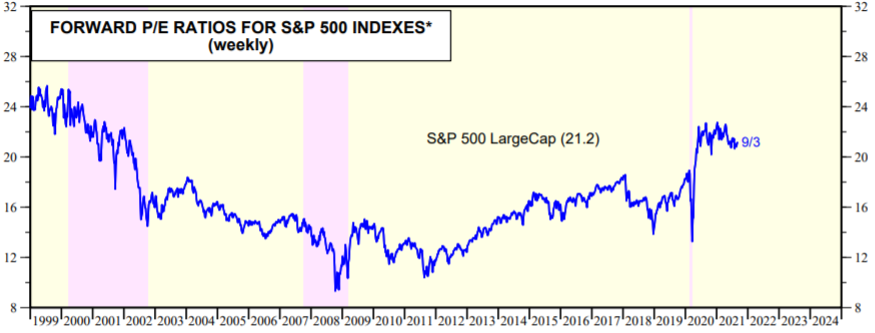
On most measures, equities don’t look cheap, that’s for sure. A frequently used measure is the Price-Earnings ratio, or the P/E, which takes the share price of a company divided by its expected earnings (profits). The US is the largest stockmarket so let’s use that as a representation for equity valuations. The first chart shows the P/E for the S&P500 index (think: the US version of the FTSE100). As you can see, the current level of 21.2x doesn’t LOOK cheap … (source: Yardeni Research).
Is P/E the correct measure to use?
The problem with using a valuation measure like the P/E is that it doesn’t tell the whole story. One of the reasons equities have KEPT rising, and can KEEP rising, is that interest rates are ultra-low. Historically, interest rates have averaged 5-6%. Today they are near zero. Interest rates MUST be accounted for because they are FUNDAMENTAL to the economy, company profits and equity performance. Read my article on “TINA” which covers this.
So a P/E of 21.2x in today’s world of easy policy and low rates has a very different meaning to a similar P/E when policy was tight and rates were high … i.e. you can’t compare the two.
A more relevant measure …
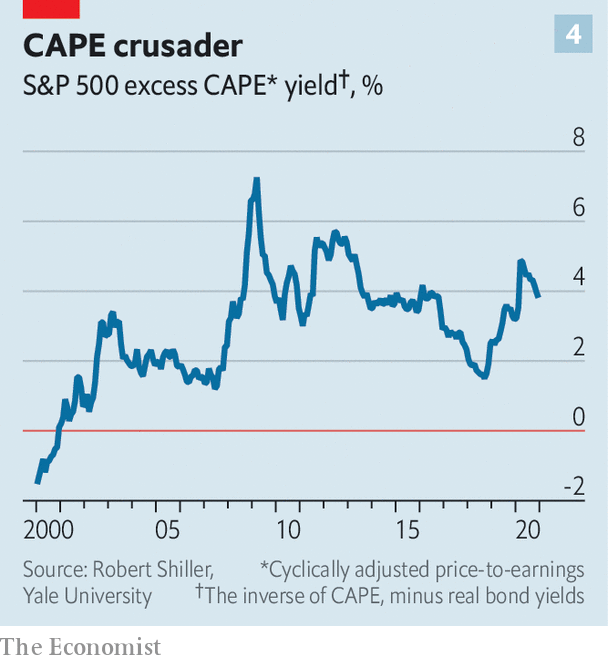
A valuation measure incorporating interest rates is far more relevant given how the world has changed. A measure that combines the P/E and interest rates is the Excess CAPE Ratio, as shown in the chart below. You can read more about the Excess Cape Ratio here.
This shows the Excess CAPE Ratio over time, revealing equity valuations to be pretty reasonable on this measure …
Although I remain positive on markets, I would welcome a sell-off as that would be healthy AND provide an opportunity to buy cheaper.
What makes investing fascinating is the existence of many different views and measures. But, ultimately, it’s the market that decides what’s right. Over time, the market has indeed been a trustworthy indicator of the true value of companies and equities.
What if you have capital sitting around but remain cautious?
1. Pound-Cost Averaging
Here, you win both ways. If markets keep going up, you make money on the amount invested. In a sell-off, you’re also happy as you get to buy at lower prices.
This means drip-feeding your capital into the markets over time. You choose the time period and the frequency (monthly, quarterly etc) but do it on a regular basis according to the original schedule you set.
2. Invest in a Balanced ETF or Fund
Instead of making a binary decision, that is to either go all-in equities or stay in cash, cautious investors can go for a balanced strategy consisting of, say, 40% equities and 60% bonds. The bond element provides protection in case of a sell-off but still earns better than cash … you will know my views on inflation and holding too much cash. Read my previous article around inflation here.
For more of this …
If you like the idea of setting up a diversified, set-and-forget compounding portfolio using a simple 3-step process, learn more about the Investment Accelerator here and see how others did it.
➡️ For a brief chat with me on how we can help you, book a call with me here.
Written by Manish Kataria, CFA, former JP Morgan fund manager and founder of the Investment Accelerator.
Remember:
NOBODY will care about your money like YOU will ...
The Investment Accelerator has transformed how thousands of people now invest. Creating diversified passive portfolios for Growth and Recurring Income.

And Always Remember:
- Time in the Markets always beats timing the markets
- Stay Diversified
- Think Long-term and beat inflation
- Minimise those leakages
- Passive beats Active
- Stay educated to outperform 99% of the population ...
- Investing this way is the key to achieving passive financial freedom
Last but not least ...
- Don't take the above as advice as it may not apply to you personally
- Your Capital is at Risk
- You may not be covered by the FSCS
- Anything mentioned in a video, podcast or in a previous article was valid at that time and may not continue to be now
- Past performance is not a guide to future performance. Individual results vary.