Probably more than you think. 3 quick checks you can make now …
✍️ By Manish Kataria, CFA. My own views from 20+ years as a professional investor, not Ai's.
Key points
- Between 1 October and 13 November 2026, Nvidia fell 29%, chip stocks 21% and the Nasdaq approx 6%
- Over the same period, UK and European stocks and gilts rose, as did global dividend stocks and defensive sectors
- An S&P500 tracker is 100% US and approx 40% tech. Even a standard global tracker is approx 60-70% US and 1/3 tech
- Workplace pensions and managed funds are often just as US-heavy, so check ALL your accounts together
💡 Want insights like this every week, direct to your inbox? Just leave your details in the box at the top of this page ☝🏼
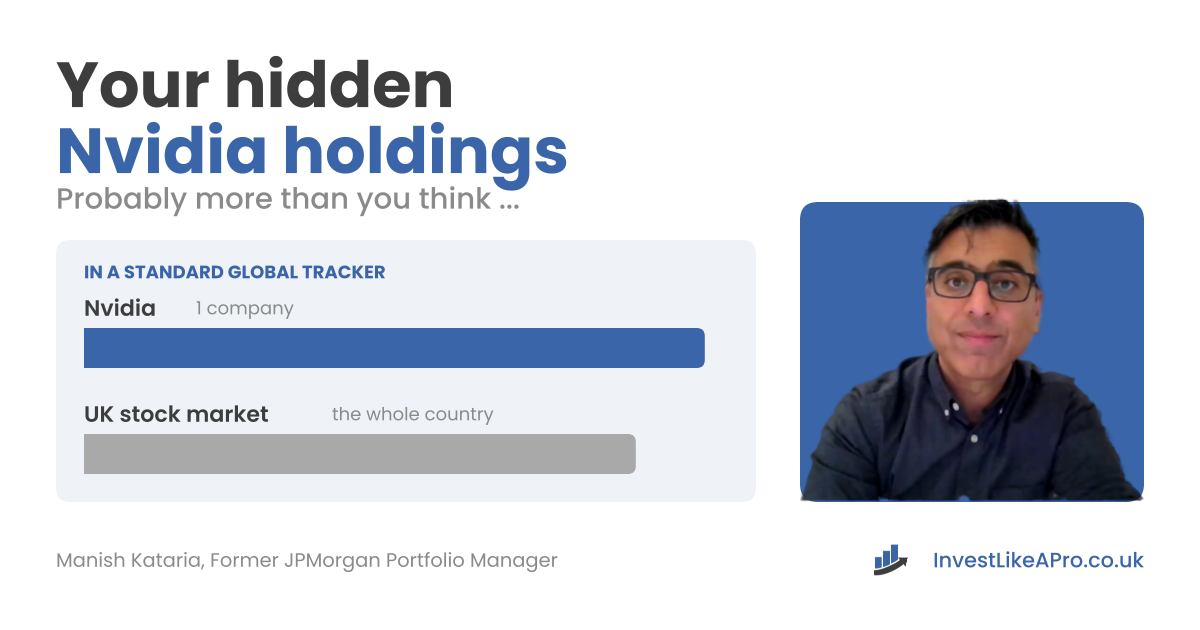
If you own an S&P500 tracker, a global tracker, a workplace pension or a managed portfolio, you probably own more Nvidia (and more US tech) than you think. Even if you’ve never bought a single Nvidia share.
At the start of October 2026, approx £8 in every £100 in an S&P500 fund was in Nvidia. In a standard global tracker, approx £5. Here’s why that matters, and 3 quick checks you can make on your own portfolio.
What happened to Nvidia in late 2026?
I’d previously written: don’t just pile into the S&P500 or US tech. A few weeks later, Nvidia underlined why.
In November 2026, Nvidia’s founder and CEO Jensen Huang resigned. It wasn’t a usual month for a chip company!
Between 1 October and 13 November 2026, Nvidia fell 29%. Chip stocks fell 21%. And the Nasdaq was approx 6% lower (it was down nearly 10% at one point).
And here’s what all investors should know: you’re probably more exposed to Nvidia than you might think, even if you don’t intentionally own a single share …
Who has hidden Nvidia exposure?
This applies to you if you’re:
- Holding the S&P500 or a global tracker fund
- Paying a wealth manager or adviser to run your money, without knowing what’s held on your behalf
- In a workplace pension, not knowing what’s inside it
- Or managing your own portfolio and not sure how much tech/Ai you really own
How much Nvidia is in an S&P500 or global tracker?
If you own an S&P500 ETF or fund, approx £8 in every £100 was in Nvidia at the start of October 2026 (by mid-November, that £8 was worth under £6).
A standard global tracker? Approx £5 in every £100. More than the whole UK stock market. And more than France and Germany combined! (as of 1 October 2026)
Global tracker % weights: Nvidia vs selected countries (as of 1 Oct 2026) …
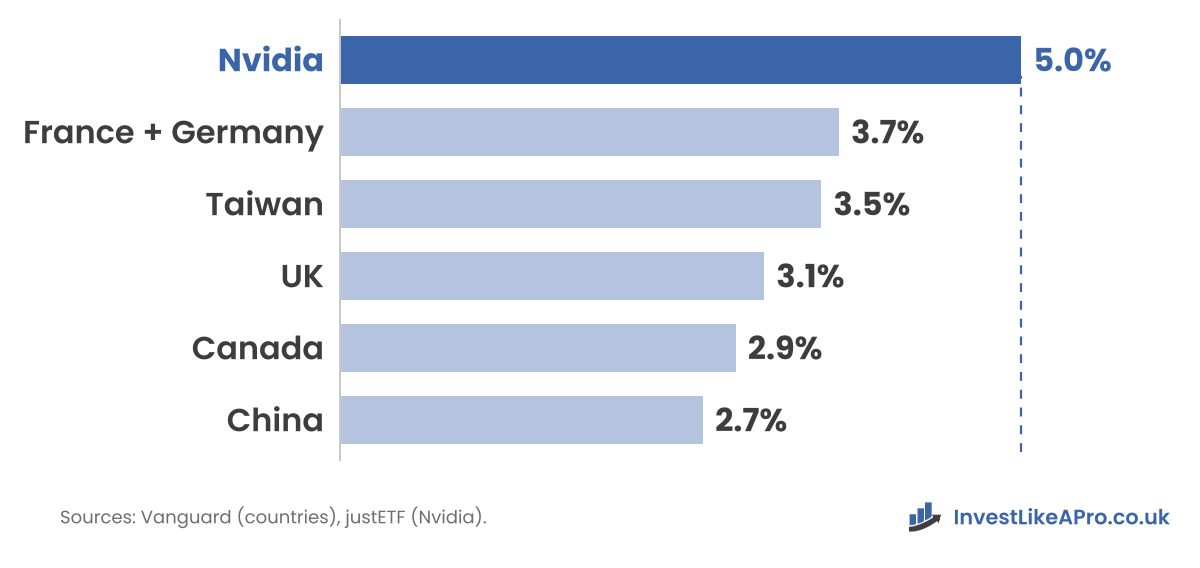
In numbers, at 30 September 2026: Nvidia 5.0% of a standard global tracker, France and Germany combined 3.7%, Taiwan 3.5%, the UK 3.1%, Canada 2.9% and China 2.7%.
Can you go wrong with the S&P500?
‘You can’t go wrong with the S&P500’ is probably the most repeated investment advice on the internet. Usually from people who have never looked under the bonnet.
It’s just bad advice. Why? Because the S&P500 is …
- 100% US
- Approx 40% tech
- In $: when you own US stocks, you also own the US dollar (which depreciated significantly in 2025)
A standard global tracker is better than the S&P500. But it’s still 60-70% US and approx 1/3 in tech.
To be clear: we still own US stocks and tech. They are a meaningful part of global growth.
But they don’t dominate our portfolios. More importantly, we know what our exposure is.
And so should all investors, whether you self-manage or have your money managed for you …
Are managed funds and workplace pensions any more diversified?
Many advisers just follow global trackers and passively reflect their weightings (60-70% US and 1/3 tech). And many workplace pension funds are the same.
In my experience reviewing members’ portfolios, managed portfolios are just as US-heavy. But with higher fees.
So they’ll be less diversified than you might think.
How can you check your portfolio’s US and tech exposure?
3 quick checks to make now …
- Check the factsheets of the funds or ETFs you own. They include country exposure by %. And add it up across ALL your accounts
- Look at the top 10s. Fund factsheets list their top 10 holdings. Look out for the same names (Nvidia, Apple, Microsoft etc) appearing in different funds
- Ask 2 simple questions to your adviser or work pension provider: “What % of my portfolio is in the US?” and “What % is in tech?” That kind of info is standard and readily available
Is there a better way?
We believe in balance. That doesn’t mean avoiding US stocks altogether. Just ensure they don’t dominate.
Between 1 October and 13 November 2026, while Nvidia and the Nasdaq fell, money rotated into steadier assets.
Polarised performance since 1 October 2026 …
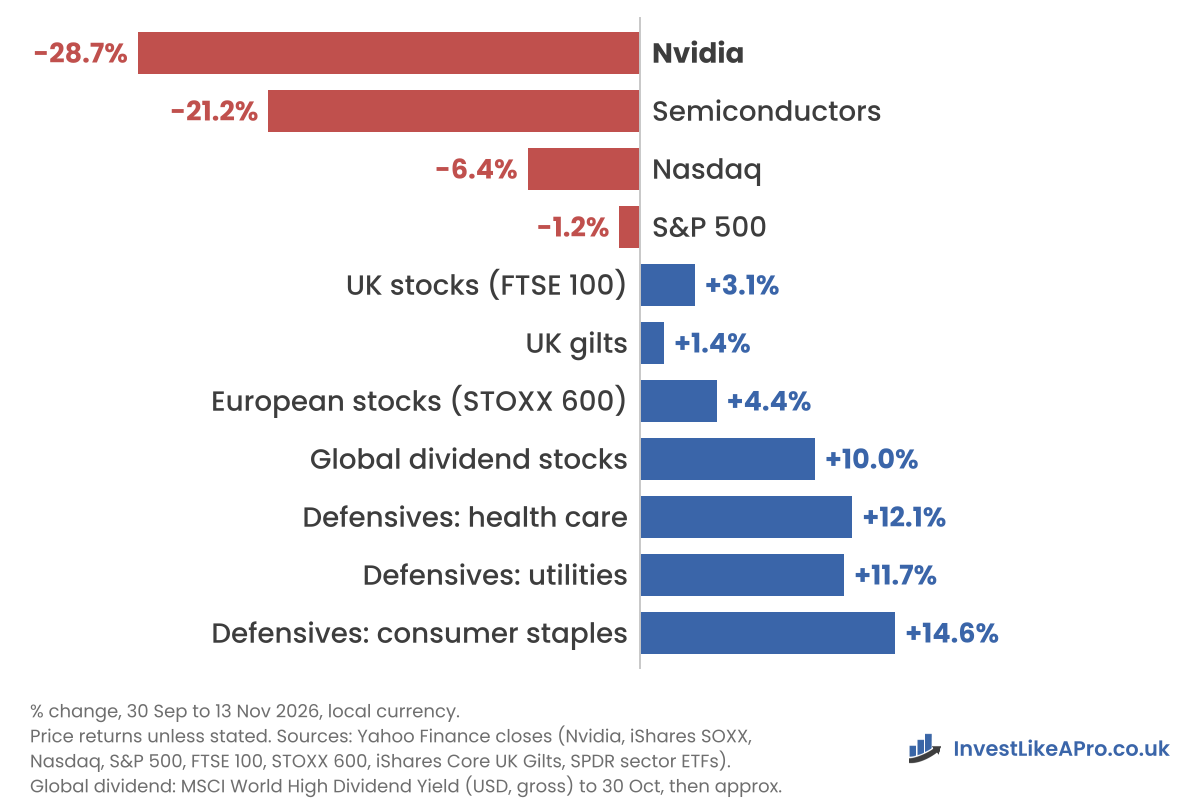
In numbers, 30 September to 13 November 2026: Nvidia -28.7%, semiconductors -21.2%, Nasdaq -6.4%, S&P 500 -1.2%. UK stocks (FTSE 100) +3.1%, UK gilts +1.4%, European stocks (STOXX 600) +4.4%, global dividend stocks +10.0%, US health care +12.1%, US utilities +11.7% and US consumer staples +14.6%.
At InvestLikeAPro, we favour properly balanced portfolios, which means you don’t need to constantly monitor or predict things (like Nvidia or tech).
Our guidelines …
- No more than 10% in any 1 stock
- Diversify your regions: UK, Europe, Asia and emerging markets, not just the US
- Spread your sectors: defensives and dividend payers, alongside growth and tech
- It’s not just stocks: bonds and gold for protection, and other middle-ground assets can make good returns
- Rebalance only if your circumstances change, not because of headlines (= Set-and-forget)
Can you do well without tech or Nvidia?
Yes, absolutely. Warren Buffett avoided tech for most of his career. His investment company Berkshire Hathaway still returned 19.9% pa from 1965 to 2024, almost double the S&P500’s 10.4%. He did pretty well avoiding tech!
And global dividend stocks (hardly any tech exposure) have returned approx 8.6% pa over the 10 years to September 2026. More than doubling your money in 10 years. All without Nvidia.
Remember: stable returns compound much better long term than spectacular ones.
➡️ Want help checking how much of your money really sits in the US, tech and Nvidia? Grab a quick call
Have your portfolio X-Rayed …
Our Investment Accelerator members can have their existing portfolio evaluated with professional analysis. That’s included in either a 1-1 personalised meeting or in a live class.
We help break down everything they own and see how concentrated their portfolio really is. Property included. Then they take action to rectify things.
Want a portfolio that doesn’t depend on Nvidia (or any 1 stock)?
Grab our Free Investment Toolkit. A good first step towards a properly balanced, set-and-forget portfolio.
Written by Manish Kataria, CFA, former JP Morgan fund manager and founder of the Investment Accelerator.
Remember:
NOBODY will care about your money like YOU will ...
The Investment Accelerator has transformed how thousands of people now invest. Creating diversified passive portfolios for Growth and Recurring Income.

And Always Remember:
- Time in the Markets always beats timing the markets
- Stay Diversified
- Think Long-term and beat inflation
- Minimise those leakages
- Passive beats Active
- Stay educated to outperform 99% of the population ...
- Investing this way is the key to achieving passive financial freedom
Last but not least ...
- Don't take the above as advice as it may not apply to you personally
- Your Capital is at Risk
- You may not be covered by the FSCS
- Anything mentioned in a video, podcast or in a previous article was valid at that time and may not continue to be now
- Past performance is not a guide to future performance. Individual results vary.