The stocks I’d be careful with right now …
Written by a human (me), not Ai.
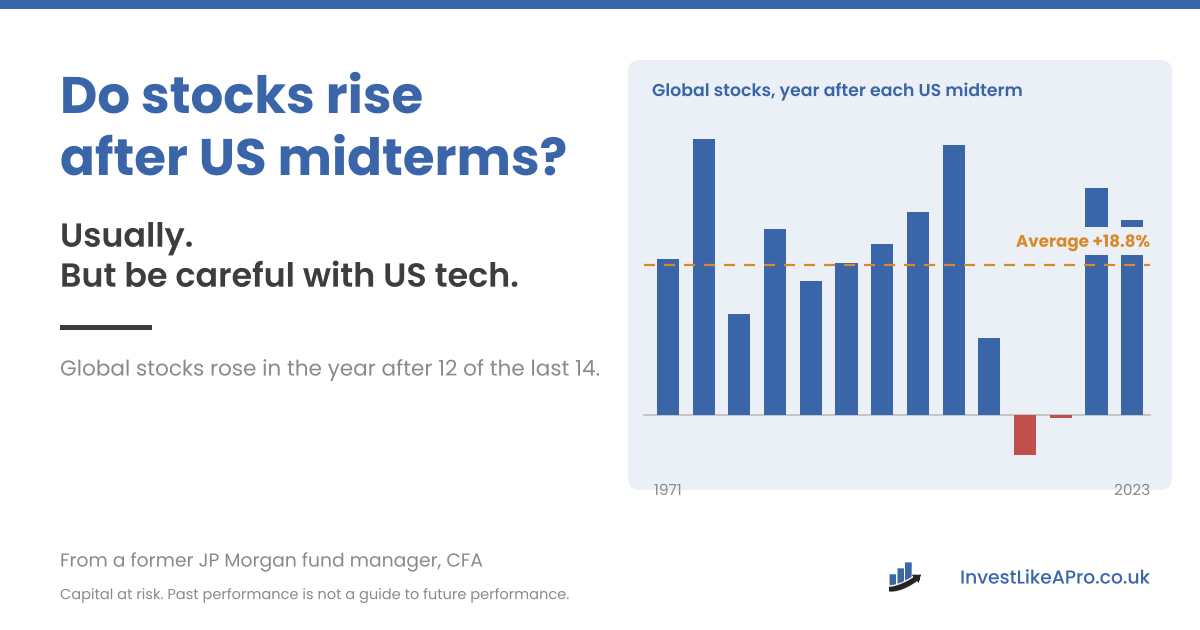
Do stocks rise after US midterm elections? History says they usually do. Global stocks rose in the year after 12 of the last 14 US midterms, by 18.8% on average.
But that doesn’t mean you should pile into the S&P 500 or US tech stocks. The 2026 midterms showed exactly why …
💡 Want insights like this every week, direct to your inbox? Just leave your details in the box at the top of this page ☝🏼
What happened after the 2026 midterms?
In November 2026, the Democrats won both the House and the Senate.
Markets rallied on the day. But a day later, US tech sold off, with the Nasdaq down 5.5% and the S&P 500 down 4.4%.
Why? Democrats may regulate Ai more closely, especially data centres. And big tech, having cosied up to Trump and backed Republican campaigns, couldn’t expect much sympathy.
Investors were also questioning the huge Ai spend by tech companies.
Do stocks rise after midterm elections?
Usually, yes. Global stocks rose in the calendar year after 12 of the last 14 US midterms since 1970, by 18.8% on average. The only 2 down years were 2011 (-5.0%) and 2015 (-0.3%).
The US record is even stronger. The S&P 500 rose in the 12 months after all 19 midterms since 1950.
Because … once the result is in, the election uncertainty clears and markets refocus on earnings.
At InvestLikeAPro, we follow the evidence, not speculation or predictions …

Should you pile into US tech stocks?
Some might think: Great, let’s pile into the S&P 500 or US tech stocks … ‘You can’t go wrong with them‘. Not quite …
If your portfolio is full of US and tech shares, the weeks around the 2026 midterms showed why that could be an expensive mistake.
Why be careful with US and tech stocks?
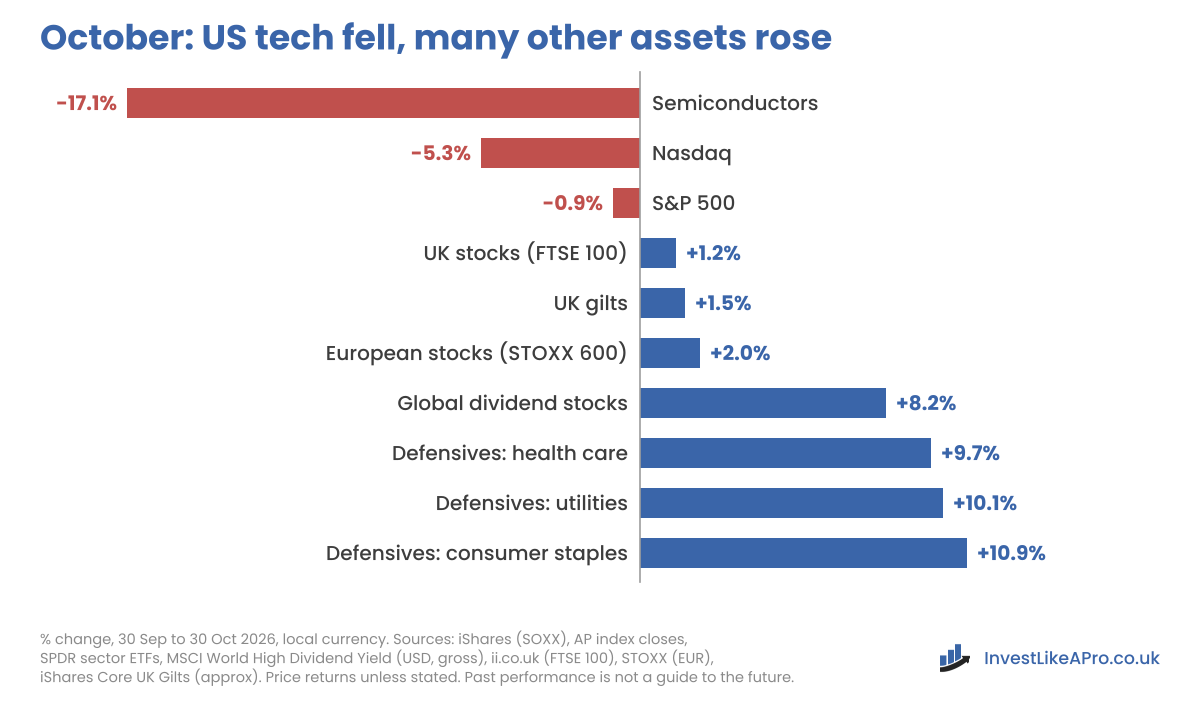
In October 2026, semiconductor stocks fell 17%. The Nasdaq fell 5% and the S&P 500 slipped 1%. (Then the S&P 500 fell 4% in a single day after the midterms.)
But many other assets rose in October. UK stocks rose 1.2%, UK gilts 1.5% and European stocks 2.0%. Global dividend stocks rose 8.2%, and the US defensive sectors (health care, utilities and consumer staples) rose 9.7% to 10.9%.
In other words, money rotated out of the big Ai spenders, into the steadier assets …
Will there be more months like this?
It’s possible. US tech companies are investing hundreds of $billions into Ai. By late 2026, 3 of the Mag 7 had negative free cash flow. Which means they were spending more than they were earning.
In October 2026, the market questioned the scale of this Ai spend. And the sell-off after the midterms showed how quickly sentiment can turn.
Is a global tracker fund diversified enough?
A global tracker fund or ETF is better than owning just the S&P 500.
But be aware that a bog standard global ETF/fund has around 70% in the US and approx 30% in tech. So it’s less diversified than you might think. (More in Own the World, Not just the S&P 500.)
And owning different tech stocks isn’t being diversified either. That’s a bit like owning 10 rental properties on the same street. It looks like 10 investments, but they all rise and fall together.
How do you build a more consistent portfolio?
Our GPI portfolios (Growth, Protection and Income) are more consistent. Why? Because stable returns have much better long term compounded returns Vs spectacular returns. A 50% fall needs a 100% gain just to get back to where you started.
That’s because the former is sustainable, the latter is not.
It’s also why I’ve been writing about more stable assets. Including:
- The Middle Ground between stocks and cash
- Lower-Risk Stocks, for a smoother ride
- And Gilts
To be clear: we still own US stocks and tech. They are a meaningful part of global growth.
But they don’t dominate our portfolios and we don’t rely on them.
Is your portfolio more concentrated than you think?
When someone joins our Investment Accelerator, they can have their existing portfolio evaluated with professional analysis. That’s included in either a 1-1 personalised meeting or in a live class.
We help them break down everything they own and see how concentrated their portfolio really is. Property included. Then they take action to rectify things.
➡️ Want to see how concentrated your money really is? Book a 15-minute call here.
What does a rate rise mean for savers and borrowers?
In November 2026, the Bank of England raised rates to 4%, its first rise since 2023, and expected inflation to rise towards 5%. Here’s how to handle a rate rise …
As a saver (or parking money for a while)
- First priority: make sure your interest rate beats inflation. UK CPI was 3.5% at the time, so aim for that, at least. As I’ve said before, the official inflation rate is understated.
- Money market funds reflect the Bank Rate, so they earn close to it, with no notice needed to withdraw. They can also be held tax-free in an ISA or pension. Useful for parking cash for a short period.
- Gilts can give more. In November 2026, a 2-year gilt yielded around 4.7%, and gilts can also be held tax-free in an ISA or pension. Outside an ISA or pension, low-coupon gilts are still highly tax-efficient, since the gain is free of CGT. For a 40% taxpayer, that was like a savings account paying over 7% (more in my gilts article).
- Remember: over the long term, financial assets make better returns than cash.
As a borrower
Whether to fix or not depends on your view of how far rates will rise. That depends on inflation, oil prices and, at the time of writing, the Middle East conflict.
So to call it, you need to get inside Trump’s head. Good luck with that!
Personally, I prefer trackers. Mainly because I like the flexibility and dislike early redemption charges.
In Summary …
- Global stocks rose in the year after 12 of the last 14 US midterms
- But October 2026 showed the risk of relying on US stocks, esp tech stocks
- A standard global tracker is around 70% US and 30% tech
- When rates rise, make sure your cash beats inflation, and park short-term money in assets such as short-dated gilts or money market funds
Frequently asked questions
Do stocks go up after US midterm elections? Historically, yes. Global stocks rose in the calendar year after 12 of the last 14 US midterms since 1970, by 18.8% on average. The S&P 500 rose in the 12 months after all 19 midterms since 1950. Past performance is not a guide to the future.
Why do stocks tend to rise after midterms? Once the result is in, the election uncertainty clears and markets refocus on company earnings.
Is it risky to put most of your money in US tech stocks? It’s a concentrated bet. In October 2026, semiconductor stocks fell 17% and the Nasdaq 5%, while global dividend stocks rose 8% and US defensive sectors rose around 10%.
How much of a global tracker fund is in the US? A standard global tracker that follows the MSCI World index was over 70% US and about 30% tech in October 2026.
Where can savers park cash when interest rates rise? Money market funds earn close to Bank Rate with no notice to withdraw. Short-dated gilts held to maturity can pay more, and low-coupon gilts are tax-efficient outside an ISA or pension.
Ps
NOBODY will care about your money like YOU will …
The Investment Accelerator has transformed how thousands of people now invest. Creating diversified passive portfolios for Growth and Recurring Income.

Manish Kataria is a CFA-qualified former fund manager with 20+ years in professional investment management. He managed portfolios at JP Morgan and other London investment houses in, across equities, ETFs, and options.He’s also a property investor (HMOs, BTLs).Through Invest Like A Pro, he teaches private investors to easily manage their own portfolios to professional standards. Without needing a financial advisor, saving thousands in fees.
Want More Insights from me ?
Did you know these emails are just one part of what I share?
Across the week, more content goes out to help investors build wealth, income, and avoid common mistakes.
Get More Value – Start here:
 Subscribe to my YouTube Channel for investment strategy, walk-throughs, and deeper dives.
And if you like different formats:
 Follow my Instagram channel for quick insights & visuals
 Get my Podcasts to learn more and multi-task whilst on the move
Listen on Apple or Spotify or Amazon Music
 Connect with me on Linkedin for further insights & commentary
 Find me on Facebook for community and insights
 I’m also
Each platform has a slightly different angle but share the same goal:
Helping you invest better with less stress.
Over time, the knowledge you gain could compound into something powerful.
Always Remember:
- Time in the Markets always beats timing the markets
- Stay Diversified
- Minimise those leakages: Fees, Inflation, and Taxes
- Financial Markets are a great source of recurring income
- ETFs, Balanced Funds and Options achieve all the above
- Being educated helps you outperform 99% of the population
… to ensure your investments work for YOUR financial freedom (not someone else’s)
And …
For more guidance, our Investment Accelerator will help you implement all of this in a step-by-step way.
Thousands of people have learnt how to diversify and pound-cost-average into low-cost, set-and-forget ETFs & Funds for inflation-beating growth. And Options to create recurring income.
Click here to learn about our Investment Accelerator
Finally …
– Don’t take the above as advice as it may not apply to you personally
– Your Capital is at Risk
– You may not be covered by the FSCS
– Anything mentioned in a podcast or in a previous article was valid at that time and may not continue to be now