The worst investment just got interesting …
Written by a human (me), not Ai.
Written in October 2026. The rates will have moved since, but the way gilts work won’t have.
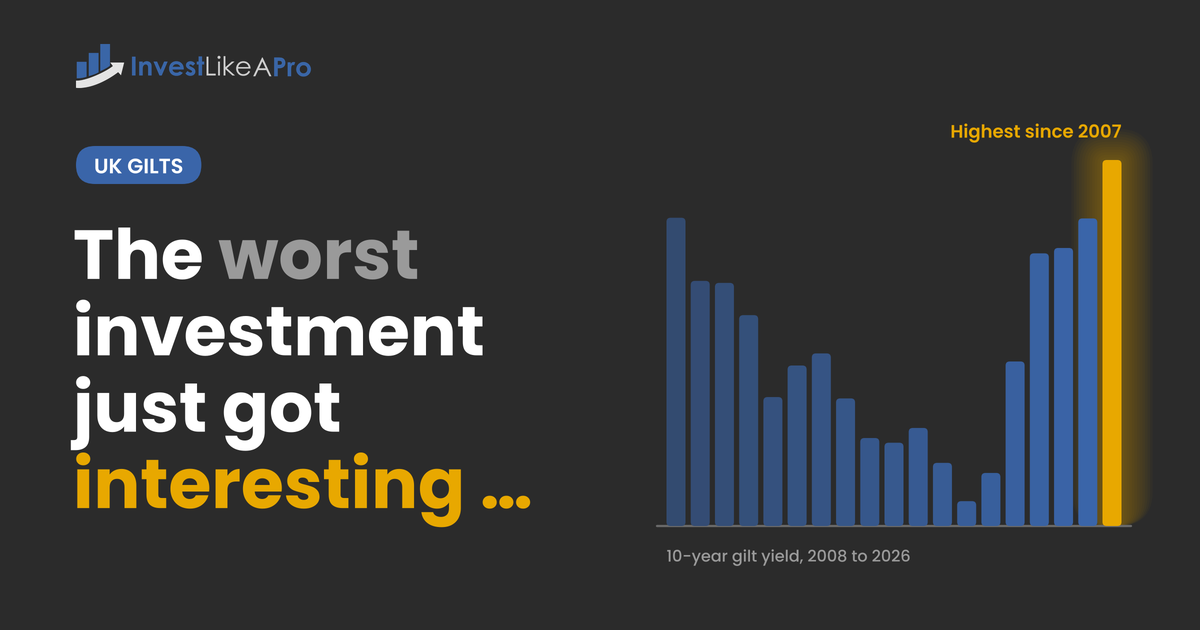
Govt bonds hit the headlines in October 2026. The 30-year gilt yield rose to 6%, its highest since 1998. The 10-year reached its highest level since 2007. As a result, the average 5-year mortgage went back up to 6%.
Not nice if you’re re-mortgaging. But there’s another side to this story …
I went through it in detail with our Investor Circle members (graduates of our Investment Accelerator). As a potential opportunity. And I wanted to share the high-level picture with you.
💡 Want insights like this every week, direct to your inbox? Just leave your details in the box at the top of this page ☝🏼
What pushed gilt yields so high?
A few things at once:
- Inflation was heading back up. It was 3.1%, and the Bank of England expected a little over 4% in early 2027, after the energy price spike from the Middle East conflict.
- Rate rises were back on the table. 3 of the 9 Bank of England rate setters voted for a rise in September 2026, and markets priced one in for November.
- The government was borrowing heavily. It planned to sell about £252 billion of gilts in 2026-27.
- It was global. US government bond yields were climbing too.
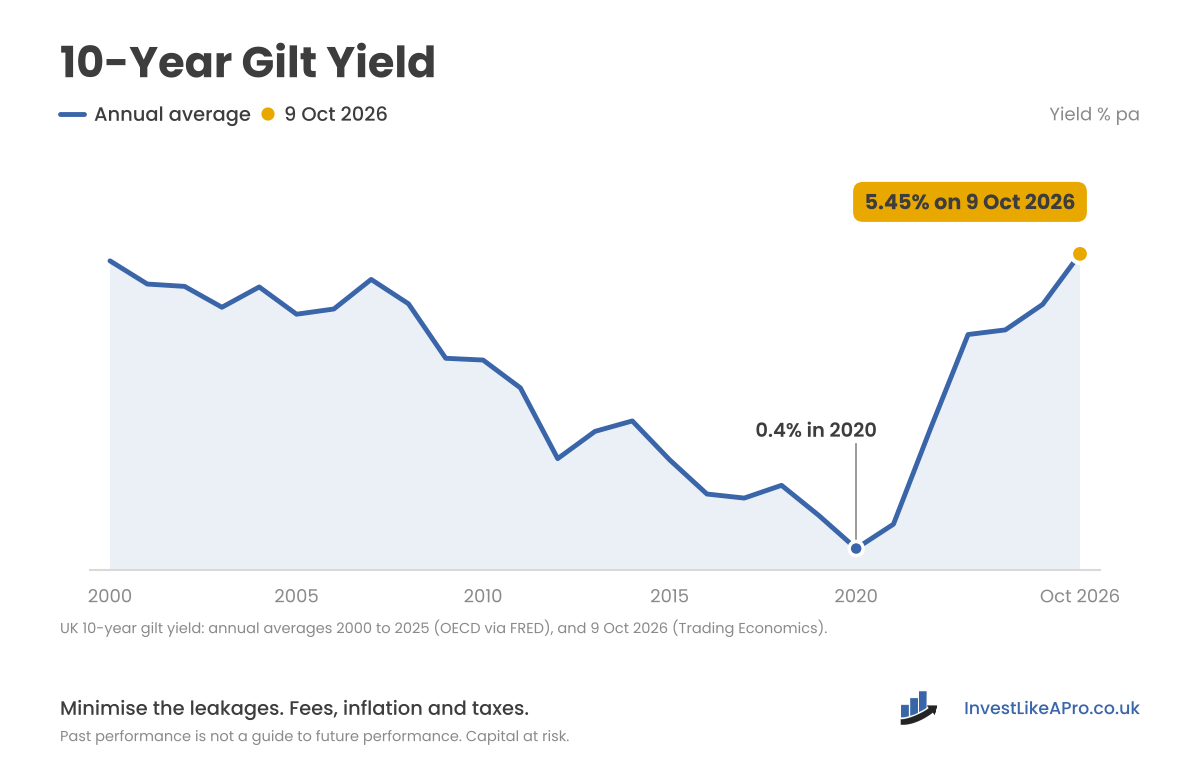
So investors wanted more to lend to the government. In 2020 the 10-year gilt yielded just 0.4% on average. On 9 October 2026 it was 5.45%.
What do higher gilt yields mean for your mortgage, pension and savings?
Your mortgage. Fixed mortgage rates are priced off swap rates, which follow gilt yields. So when gilt yields jump, fixed rates follow. By 5 October 2026 the average 2-year fix was 5.98% and the average 5-year fix 6.00%, the highest since 2023 (Moneyfacts). At the start of that September there were nearly 1,500 fixed deals under 5%. A month later there were 9.
If your fix ends in the next few months, many lenders let you lock in a new deal ahead of time, so it pays to look early. And for landlords it’s another squeeze on cashflow (another reason property struggles to fund a retirement).
Your pension. Annuity rates are priced off gilt yields too. In August 2026, a 65-year-old got about £3,650 a year from a £50,000 pot on average (Moneyfacts), before gilt yields rose further. If you have a final salary pension, transfer values usually fall when gilt yields rise. And if your workplace pension moves into bonds automatically as you near retirement, check what it holds. In 2026, many gilt funds were still well below where they were 5 years earlier.
Your savings. Fixed savings rates rose too. In September 2026 the average 1-year fixed bond paid 4.28%, the highest since October 2024, and the best 2-year fixes paid about 5.15%. But the average easy access account paid just 2.53%, below inflation. And from April 2027, tax on savings interest rises to 22%, 42% and 47%, while the cash ISA allowance drops to £12,000 (unless you’re 65 or over).
Which brings me to gilts themselves.
Are bonds boring? Not so much now …
In August 2026 I shared my 5-year league table of asset returns. UK gilts came last: £1,000 became £763.
When bond yields rise, bond prices fall. So with the rise in yields, many investors went off bonds. That’s usually when opportunity arises.
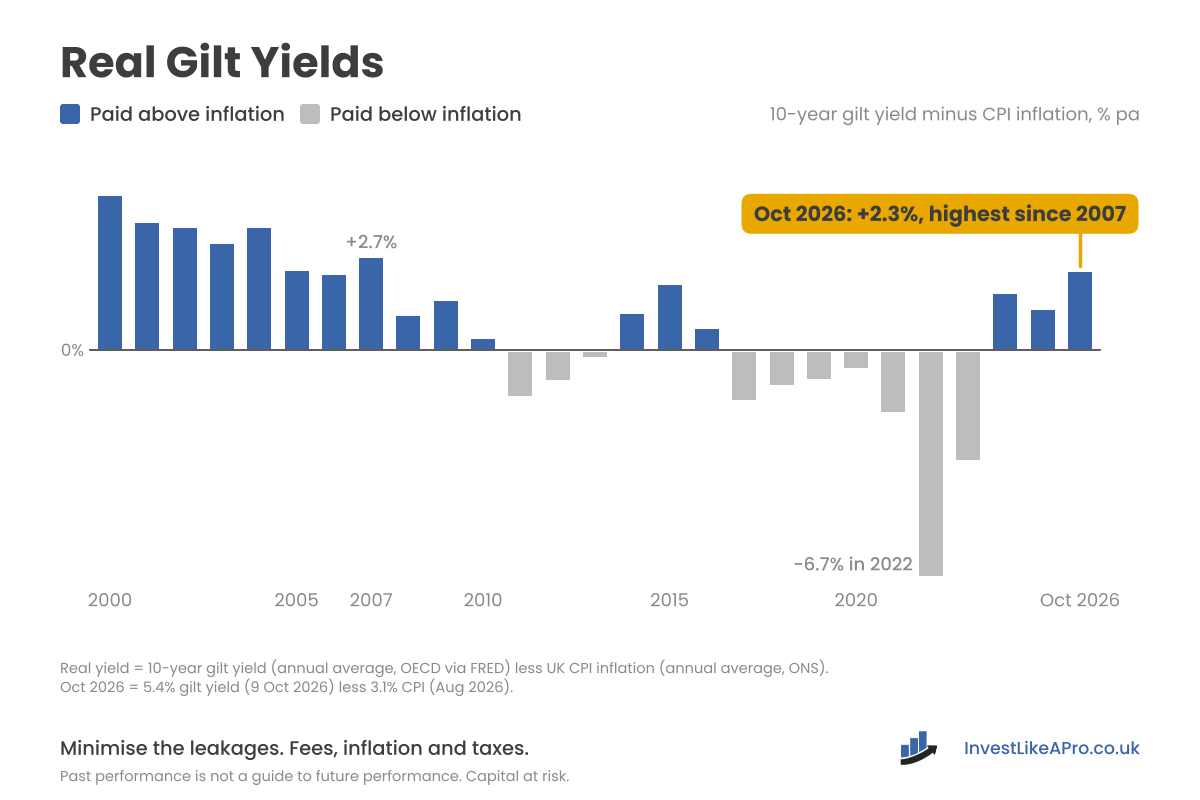
On value: yields were above inflation again (see the real yields chart below). In October 2026 the 10-year gilt yielded 5.4% vs CPI at 3.1%. That real yield of 2.3% was the highest since 2007. It was negative for most of 2010 onwards: below zero in 10 of the 13 years from 2011 to 2023, and as low as −6.7% in 2022.
Gilts also yielded more than UK shares paid in dividends: 5.4% against 3.1% for the FTSE 100. From 2011 to 2022 it was the other way round.
Normally, we talk about bonds as the P in our GPI portfolio (Growth, Protection, Income). Or as a predictable cashflow asset for retirees.
But with yields this high, we considered bonds as a tactical opportunity, particularly for cash you need to park safely for 1-3 years.
(If you’re a set-and-forget investor, stocks are still the best inflation-beating wealth-creation asset over the long term.)
What is a gilt, in plain English?
A gilt is simply a loan to the UK government. It pays fixed income (the coupon), usually twice a year. Then on maturity date, you get back £100 (backed by the UK govt) for every gilt you hold.
In between, the price moves around. When yields rise, prices fall, and vice versa. Which is why, when yields rise, many gilts trade below £100.
Can you treat a gilt like a fixed deposit?
Yes, if you hold it to maturity. Think of it as a fixed deposit with the UK govt, with a tax twist.
In our members mastermind, we highlighted several gilts maturing 2-3 years out, costing between £90-95 at the time.
Hold one till maturity when you’ll get £100 back, plus small coupons along the way. That equates to an annualised yield of approx 4.7% (the yield to maturity).
For my property investors: it’s like buying BMV, with a buyer already lined up to pay full price on a fixed date. And no tenants, toilets or boilers!
The big difference from a savings bond: you’re not locked in. You can sell on any day the market is open. But you’ll get the market price on the day, which could be higher or lower than you paid.
Similar to a fixed savings account. So nothing special so far …
Why does a low coupon matter for tax?
Here’s the twist: gilts are exempt from Capital Gains Tax. So your gain to £100 is tax-free. Only the coupon is taxed, as savings income. And if you find gilts with low coupons, there’s very little income tax to pay.
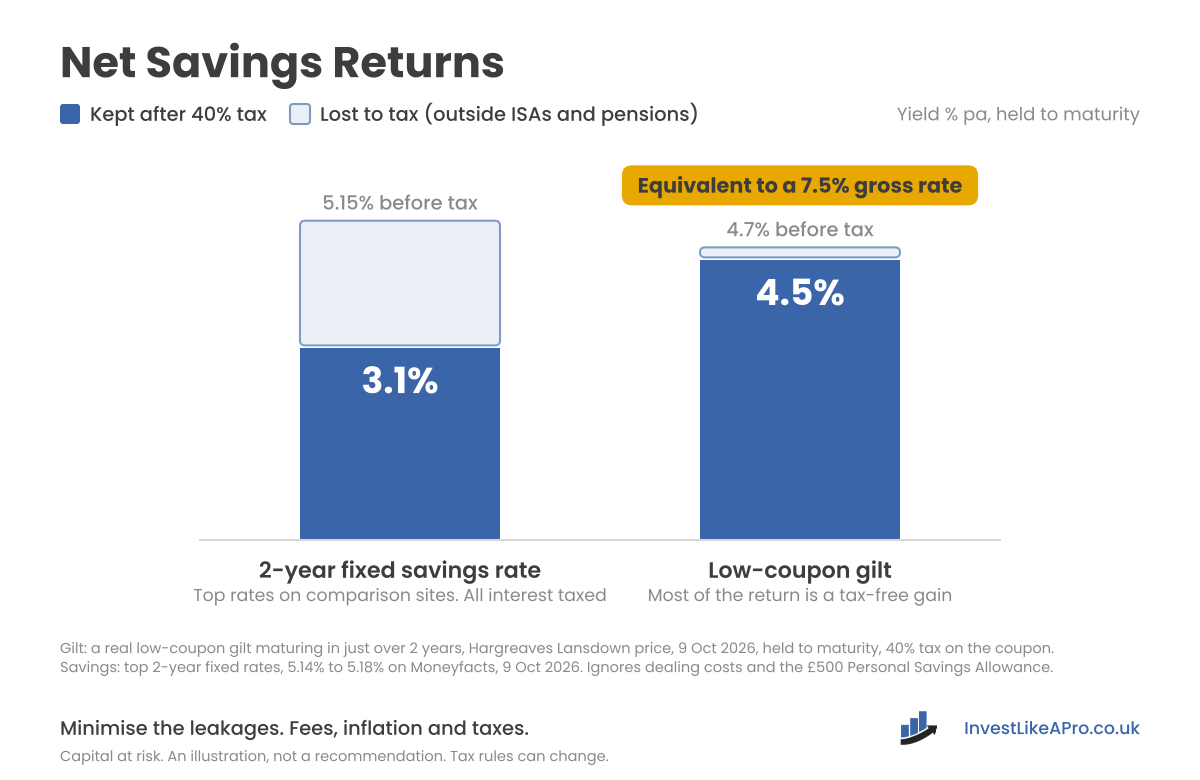
For a 40% taxpayer at October 2026 rates, where the money sits in a general account (not an ISA or pension):
- A 2-year fixed savings a/c: pays about 5.15%. You keep 3.1% after tax.
- A low-coupon gilt: yields about 4.7%. You keep 4.5%.
To keep 4.5% from a savings account, you’d need it to pay 7.5%. Or 8% if you pay 45% tax.
With a low coupon gilt, most of your return arrives as a tax-free gain, rather than taxable interest. A high-coupon gilt maturing around the same time keeps only about 3.2% after 40% tax. Same government, similar dates, over 1% a year apart.
Rates move, so these numbers will too. The logic won’t: outside an ISA or pension, a low coupon turns most of a gilt’s return into a tax-free gain. And the higher your tax rate, the more that’s worth.
Pay basic rate tax? The edge is smaller. You’d need a savings rate of about 5.8% to match, and your first £1,000 of interest is tax-free anyway.
And from April 2027, when tax on savings interest rises to 42% for higher-rate taxpayers, the gap gets wider still.
So selecting the right gilt matters. That’s exactly what our members worked through, along with how to buy them (so I’ll keep those specifics for them).
How much extra is that on £50,000?
Round numbers at October 2026 rates, for a 40% taxpayer who has already used their £500 savings allowance:
- A 2-year fixed bond at 5.15%: about £2,575 of interest a year. £1,545 after tax.
- A low-coupon gilt keeping 4.5% after tax: about £2,250 a year, mostly as a tax-free gain at maturity.
That’s roughly £700 a year more. About £1,600 by the time the gilt matures.
Could you make a capital gain too?
Possibly. If gilt yields fall, your gilt prices rise. So you could sell early with a (tax-free) profit.
But at 2 to 3 years, a 1% fall in yields only adds about 2 to 3% to the price. So think of that as a possible small bonus, not part of the plan.
Longer gilts move more. At around 5 years, a 1% fall in yields would add roughly 5%. But they’d lose a similar amount if yields rose 1%. More on that in job 4 below.
Single gilts or a gilt fund?
The tax twist only works for single-issue gilts. You don’t get the CGT exemption on gilt ETFs or funds: gains on those are taxable.
And a gilt fund (or ETF) never matures. There’s no date when it pays you back £100, so its price floats forever. That’s why the gilt ETF in my league table lost nearly a quarter in 5 years, and why many people who held gilt funds through 2022 are still sitting on losses.
A single gilt held to maturity gives you a known amount, on a known date, whatever happens in between.
Where do gilts fit in a portfolio?
When yields are this high, gilts can do 4 jobs:
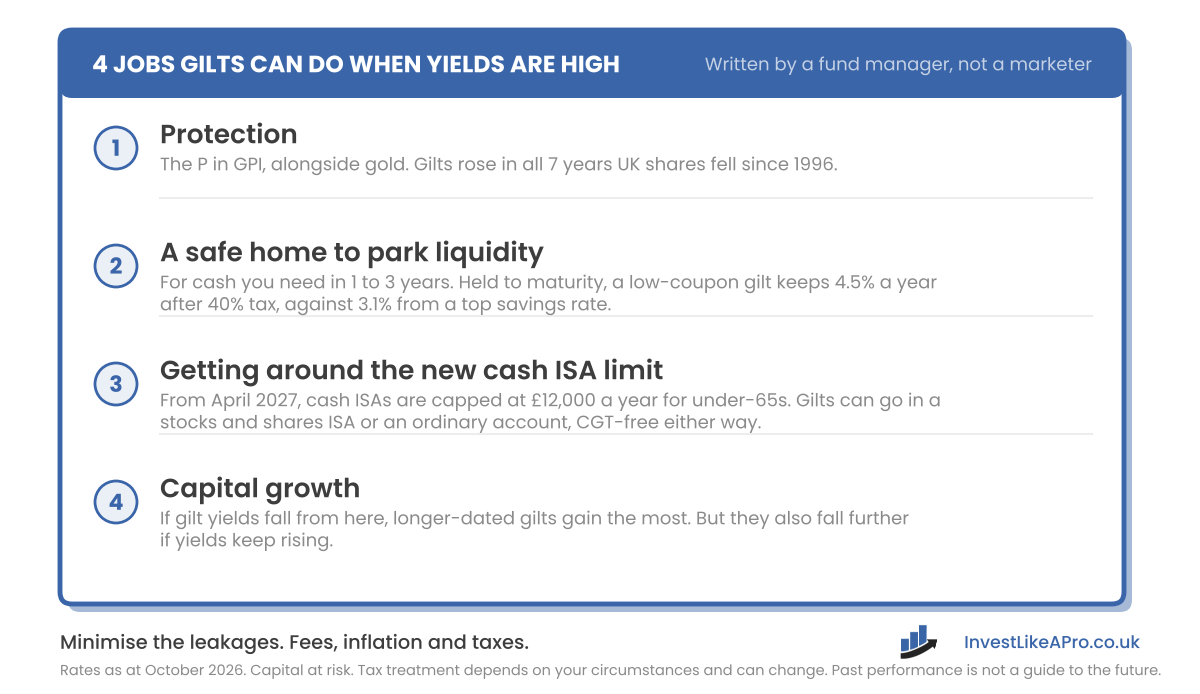
- Protection. Alongside gold, bonds are the P in our GPI framework (Growth, Protection, Income). That’s because, in the last 30 years, in the 7 times UK shares fell, gilts rose. (Their bad year was 2022, when inflation hit them hard.) They don’t replace growth though: over those 30 years UK shares returned 7.3% a year, gilts 4.5%. More in how to protect your portfolio.
- A safe home to park liquidity. For cash you know is needed in 1-3 years (house deposit, school fees, tax bills etc), or for cash held for safety, a short-dated low-coupon gilt can return far more after-tax than a savings account. For cash you need to reach any day, money market funds still do that job.
- Getting around the new cash ISA limit. From April 2027, cash ISAs are capped at £12,000 pa for under-65s. Gilts can be held in a stocks-and-shares ISA (where the £20k limit still holds) or in a general ordinary account without cap. Either way is still CGT-free. And gilts aren’t caught by the new “cash-like” test for stocks and shares ISAs, which targets money market funds.
- Capital Growth. If you think gilt yields have risen too much, and are due a normalisation (which is going against the momentum btw), longer dated gilts have the potential of decent capital gains, together with the higher yields. (Or if yields keep rising, prices will decline further.)
Higher REAL yields …
Here’s the real yield (the 10-year gilt yield minus inflation) from 2000 to October 2026, when it reached 2.3%. The last time it was higher was 2007, at 2.7%.
What are the risks?
- Hold to maturity. Gilts can be sold anytime before maturity, but the £100 capital return from the UK govt only happens on maturity date. Before that, the price can be higher or lower than you paid.
- No FSCS cover. BUT you’re lending to the UK government. In many ways that’s better than a FSCS warranty.
- The tax saving applies to General/Personal accounts not inside an ISA or pension where there’s no tax to save. And in a Ltd company, gilts are taxed as Corp Tax.
- Allowances. Higher-rate taxpayers get their first £500 of savings interest tax-free (£1,000 for basic rate), and a fixed cash ISA is tax-free anyway. So for smaller sums, or money that fits in your cash ISA, a savings account can still win.
- Inflation. If inflation runs higher for longer, a fixed return buys less. (In October 2026, the Bank of England expected it to peak a little above 4% in early 2027.)
- Tax rules can change. Everything here is based on the rules in October 2026. Check them before you invest.
In Summary …
- Gilts performed poorly in the 5 years to mid-2026. By October 2026: yields, and real yields, were the highest since 2007.
- Held to maturity, a short-dated gilt works like a fixed deposit with the UK government.
- With a low coupon, most of the return is a tax-free gain. For a 40% taxpayer in October 2026, that was like a savings account paying about 7.5%.
- Gilts can do 4 jobs: Protection, a home for cash, getting around the new cash ISA limit, and potential capital growth.
➡️➡️ Holding cash and want a clear plan for it? Book a 15-minute call here.
|
|

Manish Kataria is a CFA-qualified former fund manager with 20+ years in professional investment management. He managed portfolios at JP Morgan and other London investment houses in, across equities, ETFs, and options.He’s also a property investor (HMOs, BTLs).Through Invest Like A Pro, he teaches private investors to easily manage their own portfolios to professional standards. Without needing a financial advisor, saving thousands in fees.
Want More Insights from me ?
Did you know these emails are just one part of what I share?
Across the week, more content goes out to help investors build wealth, income, and avoid common mistakes.
Get More Value – Start here:
 Subscribe to my YouTube Channel for investment strategy, walk-throughs, and deeper dives.
And if you like different formats:
 Follow my Instagram channel for quick insights & visuals
 Get my Podcasts to learn more and multi-task whilst on the move
Listen on Apple or Spotify or Amazon Music
 Connect with me on Linkedin for further insights & commentary
 Find me on Facebook for community and insights
 I’m also
 Each platform has a slightly different angle but share the same goal:
Helping you invest better with less stress.
Over time, the knowledge you gain could compound into something powerful.
Always Remember:
- Time in the Markets always beats timing the markets
- Stay Diversified
- Minimise those leakages: Fees, Inflation, and Taxes
- Financial Markets are a great source of recurring income
- ETFs, Balanced Funds and Options achieve all the above
- Being educated helps you outperform 99% of the population
… to ensure your investments work for YOUR financial freedom (not someone else’s)
And …
For more guidance, our Investment Accelerator will help you implement all of this in a step-by-step way.
Thousands of people have learnt how to diversify and pound-cost-average into low-cost, set-and-forget ETFs & Funds for inflation-beating growth. And Options to create recurring income.
Click here to learn about our Investment Accelerator
Finally …
– Don’t take the above as advice as it may not apply to you personally
– Your Capital is at Risk
– You may not be covered by the FSCS
– Anything mentioned in a podcast or in a previous article was valid at that time and may not continue to be now
Past performance is not a guide to the future. Tax treatment depends on your circumstances and can change.