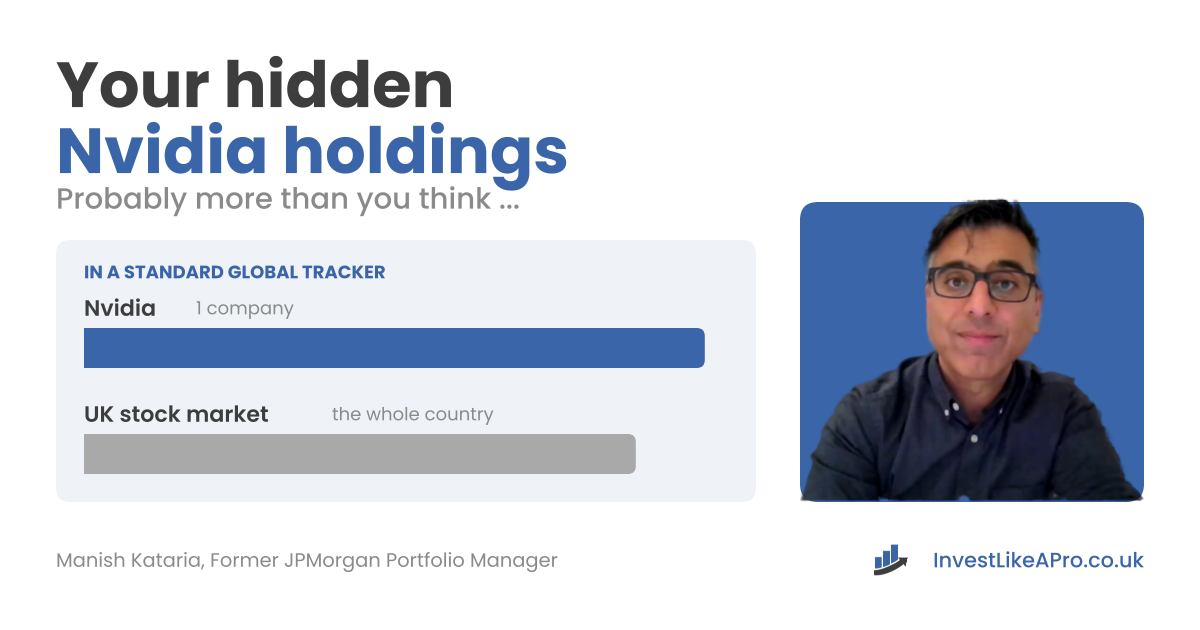
Probably more than you think. 3 quick checks you can make now …
Key points
- Between 1 October and 13 November 2026, Nvidia fell 29%, chip stocks 21% and the Nasdaq approx 6%
- Over the same period, UK and European stocks and gilts rose, as did global dividend stocks and defensive sectors
- An S&P500 tracker is 100% US and approx 40% tech. Even a standard global tracker is approx 60-70% US and 1/3 tech
- Workplace pensions and managed funds are often just as US-heavy, so check ALL your accounts together
💡 Want insights like this every week, direct to your inbox? Just leave your details in the box at the top of this page ☝🏼
If you own an S&P500 tracker, a global tracker, a workplace pension or a managed portfolio, you probably own more Nvidia (and more US tech) than you think. Even if you’ve never bought a single Nvidia share.
At the start of October 2026, approx £8 in every £100 in an S&P500 fund was in Nvidia. In a standard global tracker, approx £5. Here’s why that matters, and 3 quick checks you can make on your own portfolio.
What happened to Nvidia in late 2026?
I’d previously written: don’t just pile into the S&P500 or US tech. A few weeks later, Nvidia underlined why.
In November 2026, Nvidia’s founder and CEO Jensen Huang resigned. It wasn’t a usual month for a chip company!
Between 1 October and 13 November 2026, Nvidia fell 29%. Chip stocks fell 21%. And the Nasdaq was approx 6% lower (it was down nearly 10% at one point).
And here’s what all investors should know: you’re probably more exposed to Nvidia than you might think, even if you don’t intentionally own a single share …
Who has hidden Nvidia exposure?
This applies to you if you’re:
- Holding the S&P500 or a global tracker fund
- Paying a wealth manager or adviser to run your money, without knowing what’s held on your behalf
- In a workplace pension, not knowing what’s inside it
- Or managing your own portfolio and not sure how much tech/Ai you really own
How much Nvidia is in an S&P500 or global tracker?
If you own an S&P500 ETF or fund, approx £8 in every £100 was in Nvidia at the start of October 2026 (by mid-November, that £8 was worth under £6).
A standard global tracker? Approx £5 in every £100. More than the whole UK stock market. And more than France and Germany combined! (as of 1 October 2026)
Global tracker % weights: Nvidia vs selected countries (as of 1 Oct 2026) …
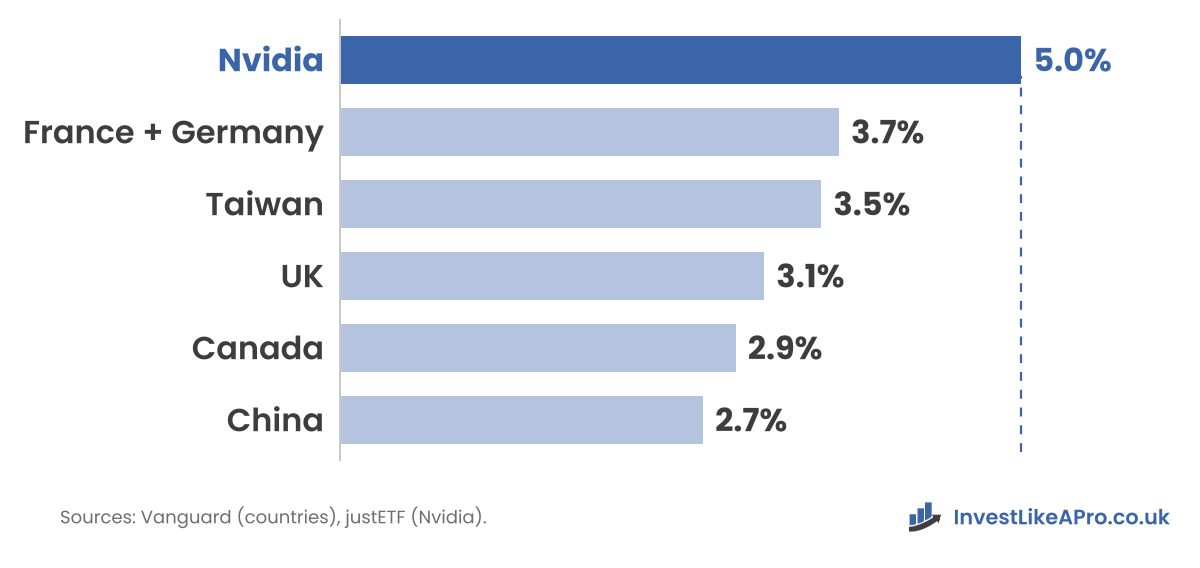
In numbers, at 30 September 2026: Nvidia 5.0% of a standard global tracker, France and Germany combined 3.7%, Taiwan 3.5%, the UK 3.1%, Canada 2.9% and China 2.7%.
Can you go wrong with the S&P500?
‘You can’t go wrong with the S&P500’ is probably the most repeated investment advice on the internet. Usually from people who have never looked under the bonnet.
It’s just bad advice. Why? Because the S&P500 is …
- 100% US
- Approx 40% tech
- In $: when you own US stocks, you also own the US dollar (which depreciated significantly in 2025)
A standard global tracker is better than the S&P500. But it’s still 60-70% US and approx 1/3 in tech.
To be clear: we still own US stocks and tech. They are a meaningful part of global growth.
But they don’t dominate our portfolios. More importantly, we know what our exposure is.
And so should all investors, whether you self-manage or have your money managed for you …
Are managed funds and workplace pensions any more diversified?
Many advisers just follow global trackers and passively reflect their weightings (60-70% US and 1/3 tech). And many workplace pension funds are the same.
In my experience reviewing members’ portfolios, managed portfolios are just as US-heavy. But with higher fees.
So they’ll be less diversified than you might think.
How can you check your portfolio’s US and tech exposure?
3 quick checks to make now …
- Check the factsheets of the funds or ETFs you own. They include country exposure by %. And add it up across ALL your accounts
- Look at the top 10s. Fund factsheets list their top 10 holdings. Look out for the same names (Nvidia, Apple, Microsoft etc) appearing in different funds
- Ask 2 simple questions to your adviser or work pension provider: “What % of my portfolio is in the US?” and “What % is in tech?” That kind of info is standard and readily available
Is there a better way?
We believe in balance. That doesn’t mean avoiding US stocks altogether. Just ensure they don’t dominate.
Between 1 October and 13 November 2026, while Nvidia and the Nasdaq fell, money rotated into steadier assets.
Polarised performance since 1 October 2026 …
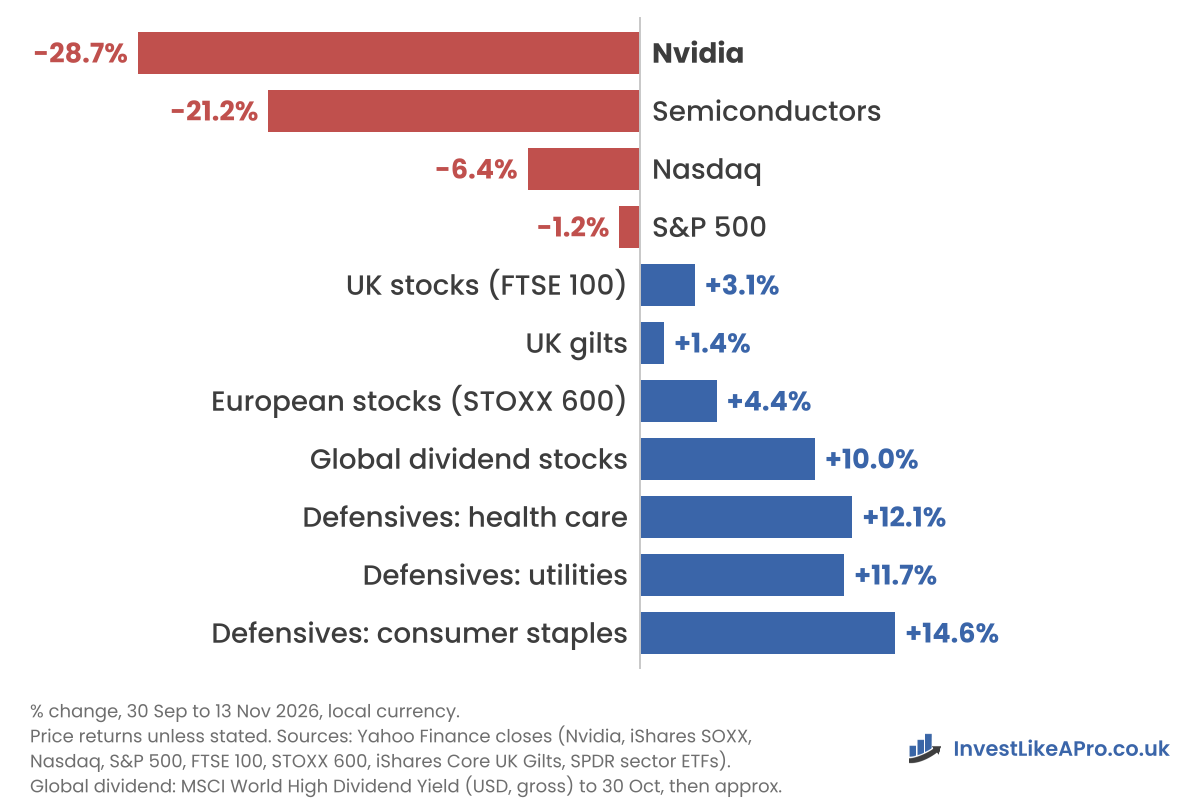
In numbers, 30 September to 13 November 2026: Nvidia -28.7%, semiconductors -21.2%, Nasdaq -6.4%, S&P 500 -1.2%. UK stocks (FTSE 100) +3.1%, UK gilts +1.4%, European stocks (STOXX 600) +4.4%, global dividend stocks +10.0%, US health care +12.1%, US utilities +11.7% and US consumer staples +14.6%.
At InvestLikeAPro, we favour properly balanced portfolios, which means you don’t need to constantly monitor or predict things (like Nvidia or tech).
Our guidelines …
- No more than 10% in any 1 stock
- Diversify your regions: UK, Europe, Asia and emerging markets, not just the US
- Spread your sectors: defensives and dividend payers, alongside growth and tech
- It’s not just stocks: bonds and gold for protection, and other middle-ground assets can make good returns
- Rebalance only if your circumstances change, not because of headlines (= Set-and-forget)
Can you do well without tech or Nvidia?
Yes, absolutely. Warren Buffett avoided tech for most of his career. His investment company Berkshire Hathaway still returned 19.9% pa from 1965 to 2024, almost double the S&P500’s 10.4%. He did pretty well avoiding tech!
And global dividend stocks (hardly any tech exposure) have returned approx 8.6% pa over the 10 years to September 2026. More than doubling your money in 10 years. All without Nvidia.
Remember: stable returns compound much better long term than spectacular ones.
 Want help checking how much of your money really sits in the US, tech and Nvidia? Grab a quick call
Have your portfolio X-Rayed …
Our Investment Accelerator members can have their existing portfolio evaluated with professional analysis. That’s included in either a 1-1 personalised meeting or in a live class.
We help break down everything they own and see how concentrated their portfolio really is. Property included. Then they take action to rectify things.
Want a portfolio that doesn’t depend on Nvidia (or any 1 stock)?
Grab our Free Investment Toolkit. A good first step towards a properly balanced, set-and-forget portfolio.
Written by Manish Kataria, CFA, former JP Morgan fund manager and founder of Investment Accelerator.
Ps
NOBODY will care about your money like YOU will …
The Investment Accelerator has transformed how thousands of people now invest. Creating diversified passive portfolios for Growth and Recurring Income.

Manish Kataria is a CFA-qualified former fund manager with 20+ years in professional investment management. He managed portfolios at JP Morgan and other London investment houses in, across equities, ETFs, and options.He’s also a property investor (HMOs, BTLs).Through Invest Like A Pro, he teaches private investors to easily manage their own portfolios to professional standards. Without needing a financial advisor, saving thousands in fees.
Want More Insights from me ?
Did you know these emails are just one part of what I share?
Across the week, more content goes out to help investors build wealth, income, and avoid common mistakes.
Get More Value – Start here:
 Subscribe to my YouTube Channel for investment strategy, walk-throughs, and deeper dives.
And if you like different formats:
 Follow my Instagram channel for quick insights & visuals
 Get my Podcasts to learn more and multi-task whilst on the move
Listen on Apple or Spotify or Amazon Music
 Connect with me on Linkedin for further insights & commentary
 Find me on Facebook for community and insights
 I’m also
Each platform has a slightly different angle but share the same goal:
Helping you invest better with less stress.
Over time, the knowledge you gain could compound into something powerful.
Always Remember:
- Time in the Markets always beats timing the markets
- Stay Diversified
- Minimise those leakages: Fees, Inflation, and Taxes
- Financial Markets are a great source of recurring income
- ETFs, Balanced Funds and Options achieve all the above
- Being educated helps you outperform 99% of the population
… to ensure your investments work for YOUR financial freedom (not someone else’s)
And …
For more guidance, our Investment Accelerator will help you implement all of this in a step-by-step way.
Thousands of people have learnt how to diversify and pound-cost-average into low-cost, set-and-forget ETFs & Funds for inflation-beating growth. And Options to create recurring income.
Click here to learn about our Investment Accelerator
Finally …
– Don’t take the above as advice as it may not apply to you personally
– Your Capital is at Risk
– You may not be covered by the FSCS
– Anything mentioned in a podcast or in a previous article was valid at that time and may not continue to be now