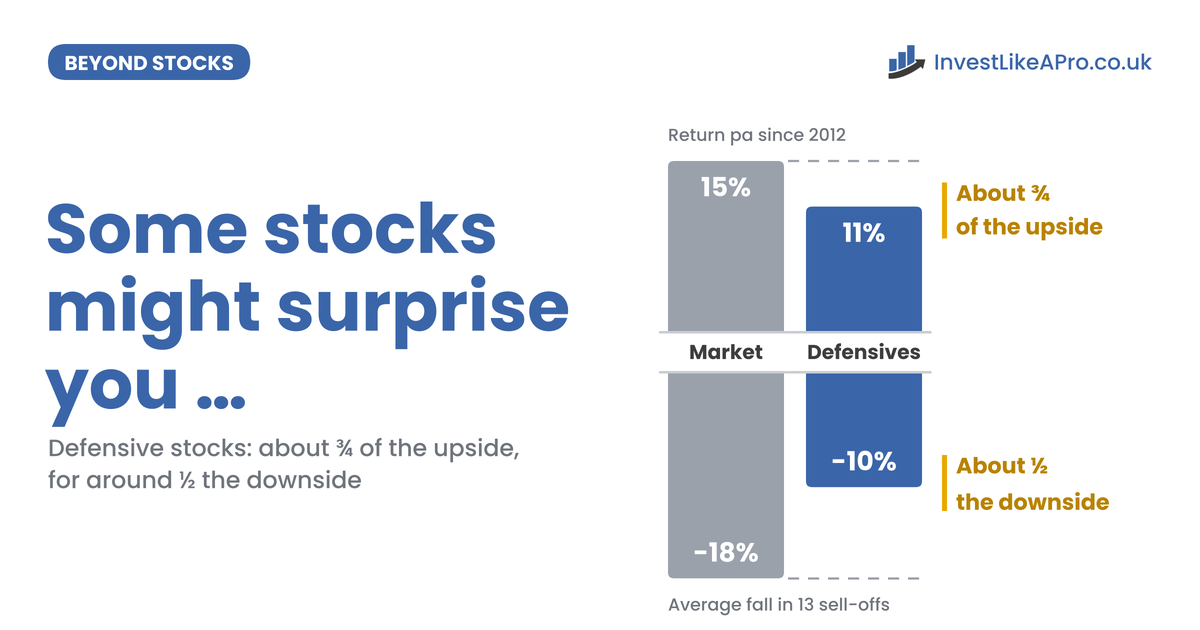
Some stocks might surprise you …
Written by a human (me), not Ai.
‘Stocks’ are not a single, uniform asset.
Within the overall market there are different segments that all behave differently. Sometimes, these segments rise when the market declines.
So you can either own the whole market or own the segments that suit YOUR risk profile. For example …
- Growth and Tech: gives you high growth in the long-term – if you don’t mind the occasional swings
- Lower-risk stocks: gives you some growth with more consistency – good for more cautious profiles
- Or a balanced mix of both
💡 Want insights like this every week, direct to your inbox? Just leave your details in the box at the top of this page ☝🏼
Who are lower-risk stocks for?
Lower-risk stocks are for you if you are:
- A cautious investor
- Retired, or approaching it
- An income investor
- Investing for a shorter time horizon
- Or just uncomfortable with how much tech/Ai you own
The good news: historically, these lower-risk segments have given roughly ¾ of the upside, for around ½ the downside …
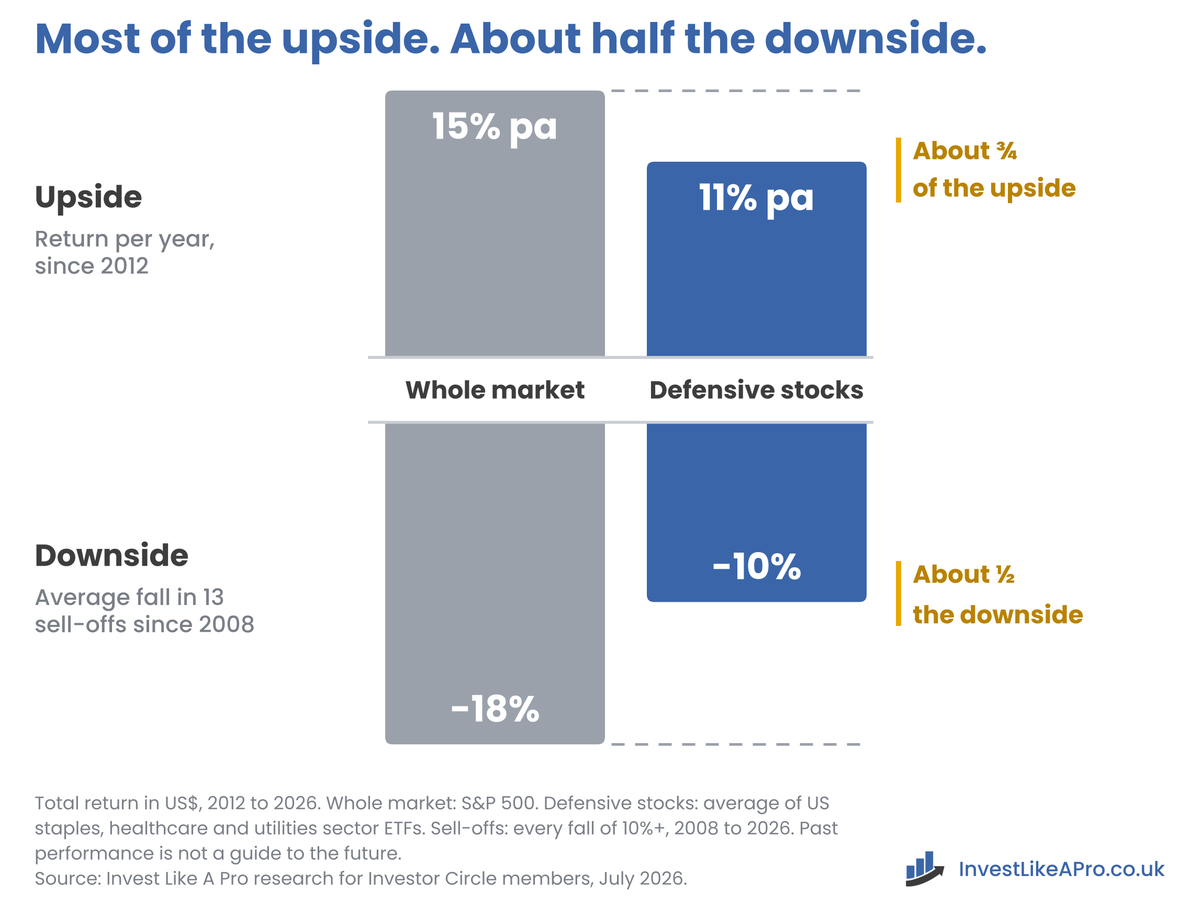
Since 2012, the US market returned about 15% pa and defensive stocks about 11% pa. That’s a pretty good trade-off for a cautious investor.
This article is part of a series on building a portfolio that suits you personally. See also Are Gilts Worth Buying Now?, How To Live Off Dividends and What to Invest in if Stocks Aren’t for You.
Where does this research come from?
I researched lower-risk stocks in detail for our members. Here, I share the high-level picture with you, including the returns.
➡️ Watch me explain all this in my latest YouTube video:
What are lower-risk stocks?
Defensive stocks are shares in companies that sell things people buy in any economy: consumer staples, healthcare and utilities.
Think about your weekly shop: toothpaste, tea bags, toiletries. And your electricity.
These are not things people cut back on when times are tough. Hence, we call them defensives.
The companies that make them have stable revenues, pay good dividends, and so tend to have more stable share prices. In fund management, we call them low beta stocks.
There are 4 main types of defensives (companies are examples, not recommendations):
1. Consumer staples. Things we buy regardless of the economy. UK: Tesco, Unilever. US: Walmart, Coca-Cola.
2. Healthcare. Medicines and medical care. Not sensitive to the economy. UK: AstraZeneca, GSK. US: Johnson & Johnson, Merck.
3. Utilities. Electricity, gas and water. Needed daily regardless. UK: National Grid, SSE. US: Duke Energy, Southern Company.
4. High-dividend Stocks. Quality blue-chip companies with stable cash flows and strong balance sheets. And they pay higher dividends (more on income below). UK: National Grid, GSK. US: PepsiCo, Verizon.
Note: individual companies in a safe sector can disappoint. That’s why we screen properly, or use a fund/ETF to spread the risk. (More in my 7 Types of Stocks article.)
How defensive are they?
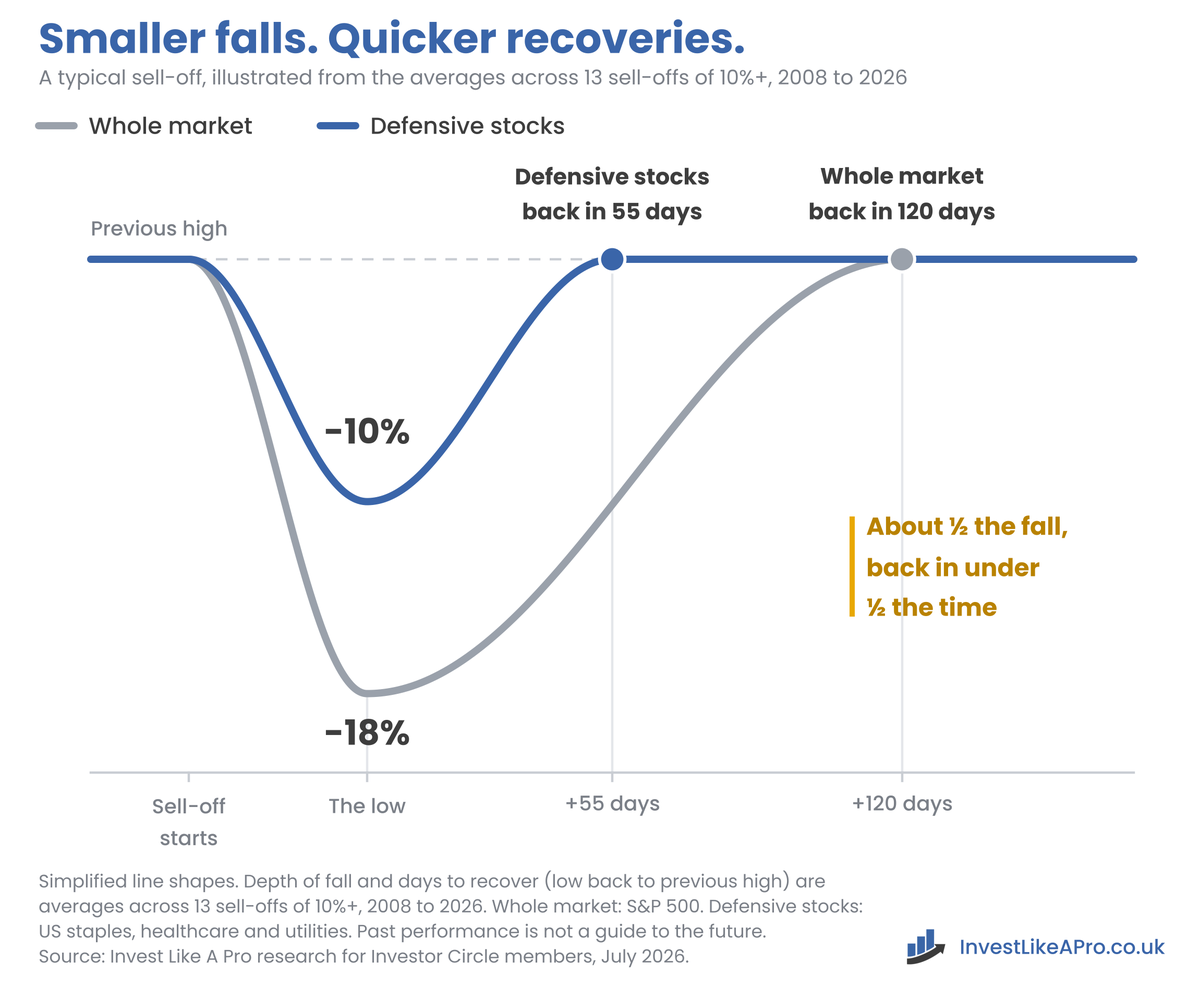
Our research shows that in 13 sell-offs since 2008, defensive stocks fell 10% on average, against 18% for the market, and recovered in 55 days against 120.
I wanted real evidence. So I back-tested 53 different ETFs and stocks, using 20+ years of data.
I checked 13 market sell-offs, from the 2008 crash to 2026, including Covid and the 2022 bear market.
In a typical sell-off of 10% or more …
- The market as a whole fell 18% on average, and took 120 days, on average, to fully recover
- Defensive stocks fell 10%, and fully recovered in 55 days, on average
- High dividend stocks fell 12%
So defensives fell roughly half as much. And recovered in under half the time.
And high dividend stocks? In every sell-off since 2015 (6 of them), they were one of the 2 best-performing segments in the whole market.
What’s the catch with defensive stocks?
When tech is flying (like the last few years), defensives won’t match them. Which is what you’d expect.
And they can still fall when the market falls. Just less (and sometimes rise). So they smooth the ride, not always hedge it. For a true hedge, you need gold and government bonds (the P in our GPI portfolio).
To be clear: for set-and-forget portfolios with a long-term growth horizon, global stocks (the whole market) are still the default choice.
But for those more cautious, in/approaching retirement, needing stable income, or with short time horizons … defensives and high dividends can be highly effective.
Do defensive stocks pay an income?
Yes. Many defensive and high dividend stocks pay regular dividends, and most can earn Options income on top.
Income is a big gap for tech and growth sectors. Eg Tesla has never paid a dividend. And Nvidia pays 0.47%pa.
But a UK dividend fund/ETF pays approx 5% yield. And when we screen for individual dividend stocks, our sweet spot is 4-7% pa. (More in How To Live Off Dividends.)
Many of these companies have paid dividends through recessions, crises, the pandemic etc. So as you wait for markets to recover, you’re still getting paid.
And .. most of these stocks and ETFs can also earn Options income on top. Think of it as renting them out, like property, for a monthly premium.
For income investors, consistency beats excitement. And because defensives tend to fall less and recover sooner, you’re less likely to be stuck waiting before you can rent them out again.
(Options need specialist knowledge, so learn them properly before you start.)
Our own research, shared with members …
This research is our own. Not something I pulled off the internet.
I first shared it with our Investment Accelerator members so they could apply it in their own portfolios: the actual ETFs and stocks, and the best ones for Options.
➡️ Want to see how lower-risk stocks could suit your portfolio? Book a 15-minute call here.
In Summary …
- Not all stocks are the same
- Defensives sell what we need, whatever the economy
- Defensive stocks tend to capture ¾ of the overall market’s upside
- And they decline around HALF as much
- Defensives tend to fully recover in under half the time
- Many pay an income while you wait and can earn Options income
- High dividend stocks tend to be stable, quality companies
Frequently asked questions
What are defensive stocks? Shares in companies that sell things people need in any economy, such as consumer staples, healthcare and utilities. They tend to fall less than the wider market in a sell-off.
Are defensive stocks lower risk? They have historically fallen less. In 13 sell-offs since 2008, defensive stocks fell 10% on average, against 18% for the market. They can still fall, so they smooth the ride rather than hedge it.
Do you give up returns with defensive stocks? Some. Since 2012, US defensive stocks returned about 11% pa, against 15% pa for the US market. That’s roughly ¾ of the upside.
Who should consider lower-risk stocks? Cautious investors, those in or approaching retirement, income investors, and anyone investing for a shorter time horizon.
In Summary …
- There’s much more to passive investing than just stocks
- Stocks are a core investment. But won’t suit everyone
- Cautious, retired, or need the money soon? The middle-ground assets could suit you
- All of these can be passive, go in your ISA or pension, and many can earn options income too
Ps
NOBODY will care about your money like YOU will …
The Investment Accelerator has transformed how thousands of people now invest. Creating diversified passive portfolios for Growth and Recurring Income.

Manish Kataria is a CFA-qualified former fund manager with 20+ years in professional investment management. He managed portfolios at JP Morgan and other London investment houses in, across equities, ETFs, and options.He’s also a property investor (HMOs, BTLs).Through Invest Like A Pro, he teaches private investors to easily manage their own portfolios to professional standards. Without needing a financial advisor, saving thousands in fees.
Want More Insights from me ?
Did you know these emails are just one part of what I share?
Across the week, more content goes out to help investors build wealth, income, and avoid common mistakes.
Get More Value – Start here:
 Subscribe to my YouTube Channel for investment strategy, walk-throughs, and deeper dives.
And if you like different formats:
 Follow my Instagram channel for quick insights & visuals
 Get my Podcasts to learn more and multi-task whilst on the move
Listen on Apple or Spotify or Amazon Music
 Connect with me on Linkedin for further insights & commentary
 Find me on Facebook for community and insights
 I’m also
Each platform has a slightly different angle but share the same goal:
Helping you invest better with less stress.
Over time, the knowledge you gain could compound into something powerful.
Always Remember:
- Time in the Markets always beats timing the markets
- Stay Diversified
- Minimise those leakages: Fees, Inflation, and Taxes
- Financial Markets are a great source of recurring income
- ETFs, Balanced Funds and Options achieve all the above
- Being educated helps you outperform 99% of the population
… to ensure your investments work for YOUR financial freedom (not someone else’s)
And …
For more guidance, our Investment Accelerator will help you implement all of this in a step-by-step way.
Thousands of people have learnt how to diversify and pound-cost-average into low-cost, set-and-forget ETFs & Funds for inflation-beating growth. And Options to create recurring income.
Click here to learn about our Investment Accelerator
Finally …
– Don’t take the above as advice as it may not apply to you personally
– Your Capital is at Risk
– You may not be covered by the FSCS
– Anything mentioned in a podcast or in a previous article was valid at that time and may not continue to be now