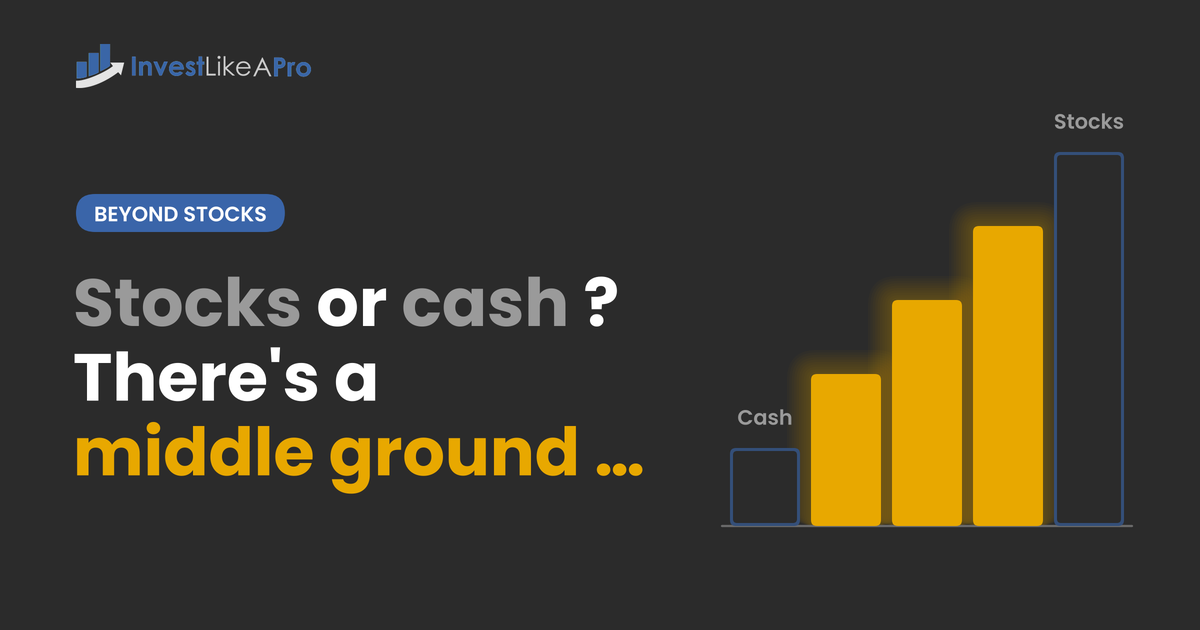
Stocks or Cash ? There’s a Middle Ground …
Written by a human (me), not Ai.
Many people think passive investing is just about stocks. But stocks may not suit everyone, depending on your situation …
For example, you might be:
- Uncomfortable with share price fluctuations
- Retired, or approaching it, and needing greater stability
- Parking cash for the short term
Stocks are still a core part of what I teach (and invest in). Over the long term, stocks have been the best inflation-beating wealth creator.
But they never rise in a straight line. And they’re not the only way.
It’s a shame that, quite often, a reluctance to own stocks means sitting in cash for too long.
💡 Want insights like this every week, direct to your inbox? Just leave your details in the box at the top of this page ☝🏼
What’s wrong with leaving your money in the bank?
Banks love to hold your cash, which they lend out to make a nice profit. That’s their business model.
More importantly, savings rates often trail inflation. And outside an ISA or pension, the interest is taxed too. So money left in the bank can quietly shrink in real terms. That erodes your real wealth.
Want to see how cash compares with other assets? My 5-year league table shows the best and worst places people parked their money.
Is there a middle ground between stocks and cash?
Yes. It doesn’t have to be a binary decision between Stocks V Cash. There’s a whole range of passive assets in between, with different risk profiles.
One example: in my article on gilts, I showed how a low-coupon gilt, held to maturity, can be seen as a fixed deposit with the UK government. And because most of its return is a tax-free gain, it can beat a savings account after tax.
These middle-ground assets still compound nicely, with low fees. And most can sit in your ISA or pension (for the tax breaks).
The only difference? Their returns and volatility …
What does volatility mean for your money?
Volatility is how bumpy the ride is: how far an asset’s price swings along the way.
As a rule, the more return an asset has delivered over the long term, the bumpier the ride. Both go hand in hand.
But a bump isn’t a loss. For a diversified investment, a fall only becomes a permanent loss if you’re forced to sell at the bottom. (More on that in Volatility v Permanent Loss.)
So the aim is to match the bumps to your situation: when you’ll need the money back, and how much bumpiness you can stomach.
How do returns and volatility compare across assets?
Think of it as a ladder …
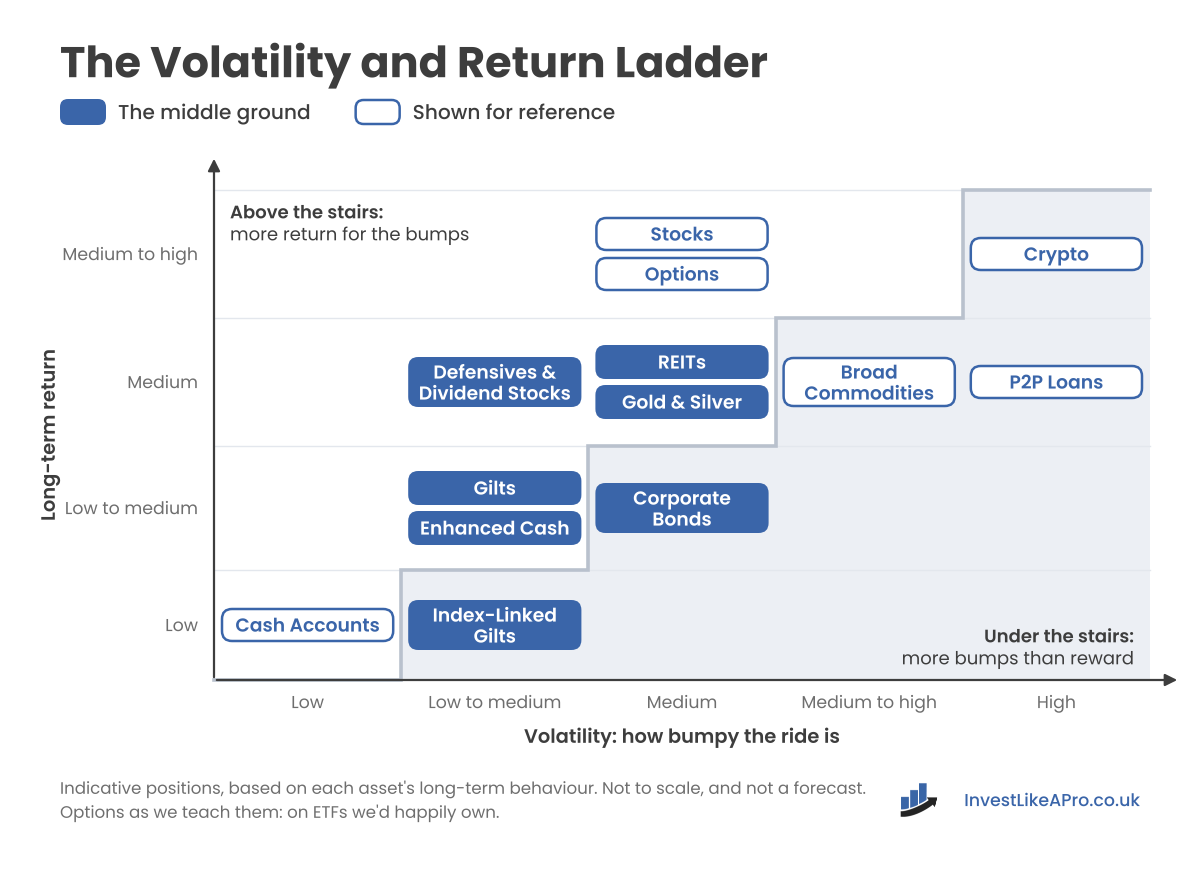
This shows typical long-term returns vs volatility for each asset type. The higher the rung, the more long-term return it has delivered. And the further right, the bumpier the ride.
Anything under the stairs has tended to have lower returns than its higher volatility would warrant.
In plain English: cash accounts and index-linked gilts sit on the bottom rung. Enhanced cash, gilts and corporate bonds are a step up. Defensive and dividend stocks, gold and silver, REITs, broad commodities and P2P loans are higher again. Stocks, options and crypto sit on the top rung. And crypto and P2P loans are the bumpiest of all.
What are the 7 middle-ground assets?
The different asset types in the middle ground …
- Enhanced Cash or Money Market Funds. These are funds or ETFs with short-term loans to governments and banks. They pay close to Bank Rate, with no notice to withdraw. They can usually be held in ISAs and pensions. (More in Money Market Funds: Why You Need Them.)
- Gilts. Loans to the UK government. Fixed income, with any gain free of Capital Gains Tax, then your capital returned at maturity. (More in Are Gilts Worth Buying Now?)
- Index-Linked Gilts. Gilts whose income and repayment rise with inflation.
- Corporate Bonds. Loans to companies. More income than gilts, for a bit more risk. Held through a bond fund or ETF, the risk is spread across hundreds of companies.
- Defensives & Dividend Stocks. Healthcare, food and household goods, utilities, and solid dividend payers. People need them in any economy, so they tend to be less volatile in a correction. (More on the different types in 7 Types of Stocks You Should Know About.)
- Gold & Silver. No income. But gold has often held up when stocks fell. I own gold as an insurance policy. (Here’s where I keep my gold.)
- REITs. Listed property owners that pay out most of their rental profits. Property income, without tenants, toilets or boilers. (More in REITs, a Smart Way to Own Property.)
Note on P2P Loans: This is lending to property developers or businesses through a platform. These loans can default, and platforms can fail. It’s entirely possible to lose ALL of your capital, unlike the assets above.
What about the assets shown for reference?
The ladder also shows a few assets outside the middle ground, so you can see where they sit:
- Cash accounts. The bottom rung, and protected by the FSCS (up to its limit). But as above, often shrinking after inflation.
- Stocks. Historically the best long-term wealth creator, with bigger bumps along the way.
- Options. Income from renting out ETFs you’d happily own, or from agreeing to buy them below today’s price. (More in Why we love Options.)
- Broad commodities. Energy, metals and farm produce. Bumpier than most, and they tend to do well when inflation rises.
- Crypto. Big gains so far, but no income behind it. And you can lose it all. (My view in Crypto: Does it Belong in Your Portfolio?)
How do these assets compare on tax, income and risk?
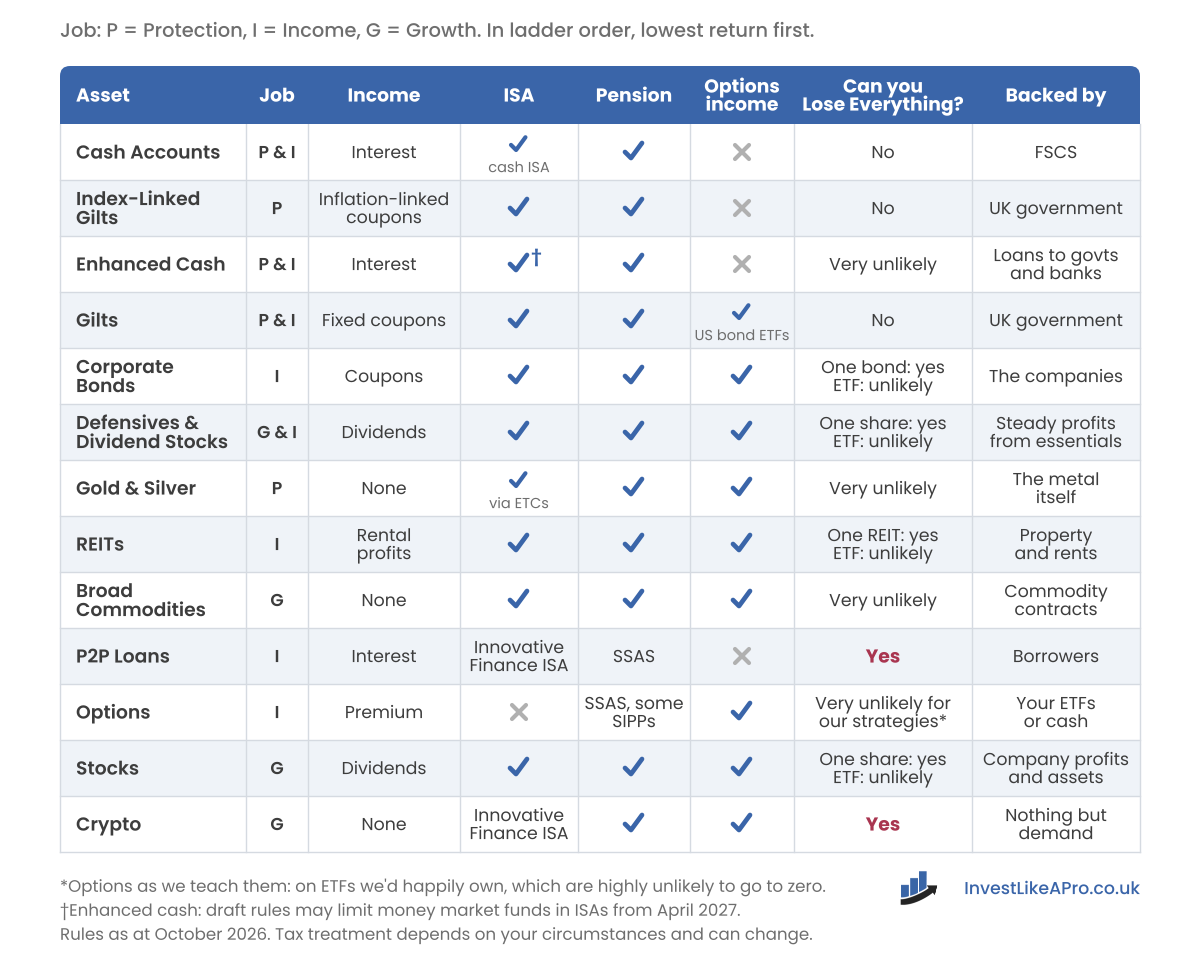
The main points:
- All of them can be held passively. Set them up, then let them compound.
- Every one fits in an ISA or a pension, or both. P2P loans, for example, can go in an Innovative Finance ISA or a SSAS.
- Many can also earn options income on top.
- Only 2 can lose you everything, however you hold them: P2P loans and crypto. A single share, bond or REIT can too (rarely), which is why we spread the risk with ETFs.
- Cash accounts are protected by the FSCS. Gilts are backed by the UK government.
Which middle-ground assets are right for you?
Think about when you’ll need the money:
- Within a year: enhanced cash
- 1 to 3 years: short-dated gilts, held to maturity, some options
- 3 to 5 years: other bonds, defensive stocks, options
- 5 years plus: stocks, defensives & dividend stocks, REITs, with some gold for protection, options
- 10 years plus: all of the above
- Retired and want a stable paycheque? Income from bonds and dividends
And you don’t need it all. A full GPI portfolio (Growth, Protection, Income) isn’t for everyone. If you’re cautious, retired, or need the money in a few years, you may not need stocks at all.
➡️ Unsure which assets might fit you? Book a 15-minute call here.
We cover all these assets in the Investment Accelerator, so you can build the mix that fits your personal circumstances.
In Summary …
- There’s much more to passive investing than just stocks
- Stocks are a core investment. But won’t suit everyone
- Cautious, retired, or need the money soon? The middle-ground assets could suit you
- All of these can be passive, go in your ISA or pension, and many can earn options income too
I’m covering each of these assets in more detail in separate articles, starting with defensive stocks.
NOBODY will care about your money like YOU will …
The Investment Accelerator has transformed how thousands of people now invest. Creating diversified passive portfolios for Growth and Recurring Income.

Manish Kataria is a CFA-qualified former fund manager with 20+ years in professional investment management. He managed portfolios at JP Morgan and other London investment houses in, across equities, ETFs, and options.He’s also a property investor (HMOs, BTLs).Through Invest Like A Pro, he teaches private investors to easily manage their own portfolios to professional standards. Without needing a financial advisor, saving thousands in fees.
Want More Insights from me ?
Did you know these emails are just one part of what I share?
Across the week, more content goes out to help investors build wealth, income, and avoid common mistakes.
Get More Value – Start here:
 Subscribe to my YouTube Channel for investment strategy, walk-throughs, and deeper dives.
And if you like different formats:
 Follow my Instagram channel for quick insights & visuals
 Get my Podcasts to learn more and multi-task whilst on the move
Listen on Apple or Spotify or Amazon Music
 Connect with me on Linkedin for further insights & commentary
 Find me on Facebook for community and insights
 I’m also
Each platform has a slightly different angle but share the same goal:
Helping you invest better with less stress.
Over time, the knowledge you gain could compound into something powerful.
Always Remember:
- Time in the Markets always beats timing the markets
- Stay Diversified
- Minimise those leakages: Fees, Inflation, and Taxes
- Financial Markets are a great source of recurring income
- ETFs, Balanced Funds and Options achieve all the above
- Being educated helps you outperform 99% of the population
… to ensure your investments work for YOUR financial freedom (not someone else’s)
And …
For more guidance, our Investment Accelerator will help you implement all of this in a step-by-step way.
Thousands of people have learnt how to diversify and pound-cost-average into low-cost, set-and-forget ETFs & Funds for inflation-beating growth. And Options to create recurring income.
Click here to learn about our Investment Accelerator
Finally …
– Don’t take the above as advice as it may not apply to you personally
– Your Capital is at Risk
– You may not be covered by the FSCS
– Anything mentioned in a podcast or in a previous article was valid at that time and may not continue to be now